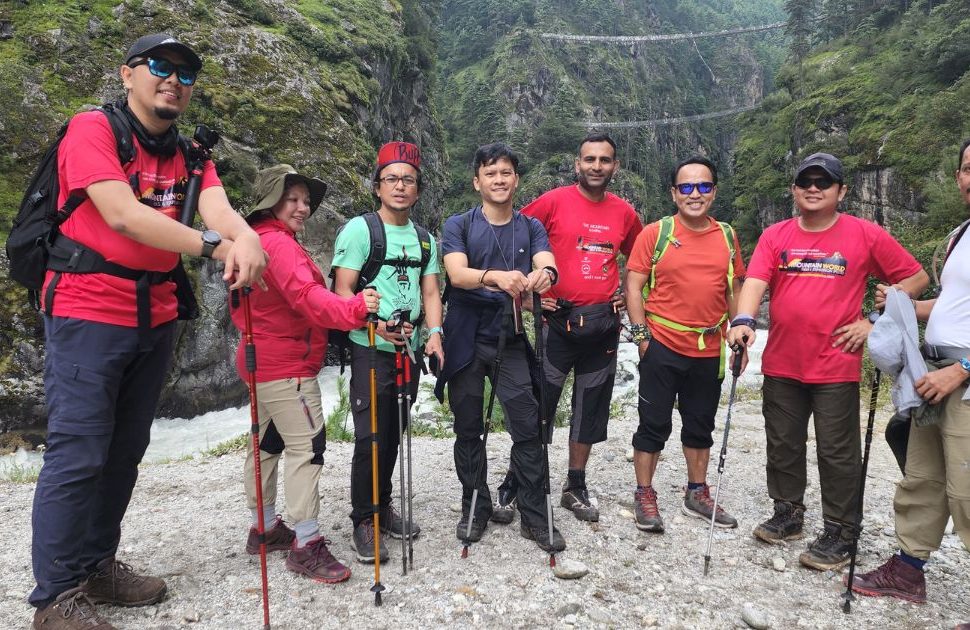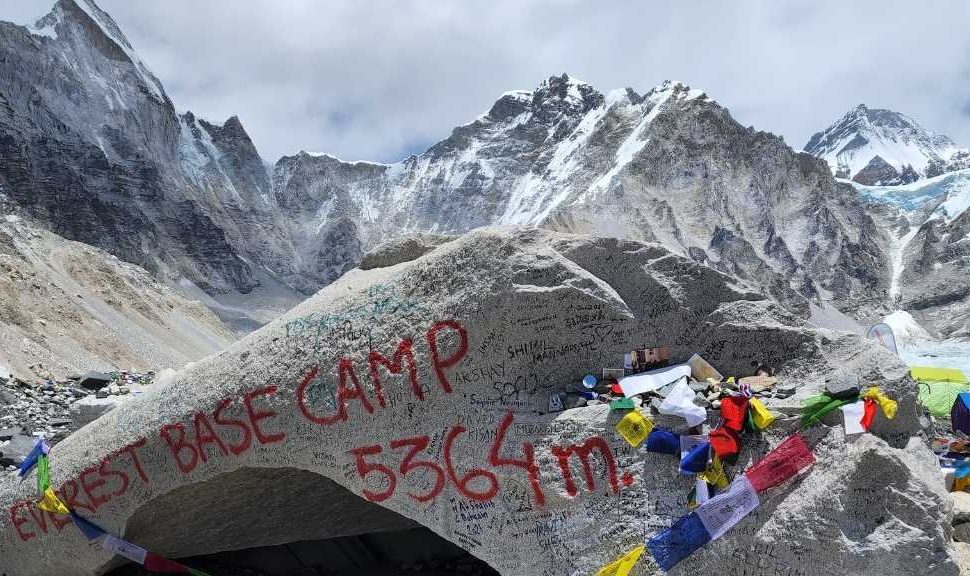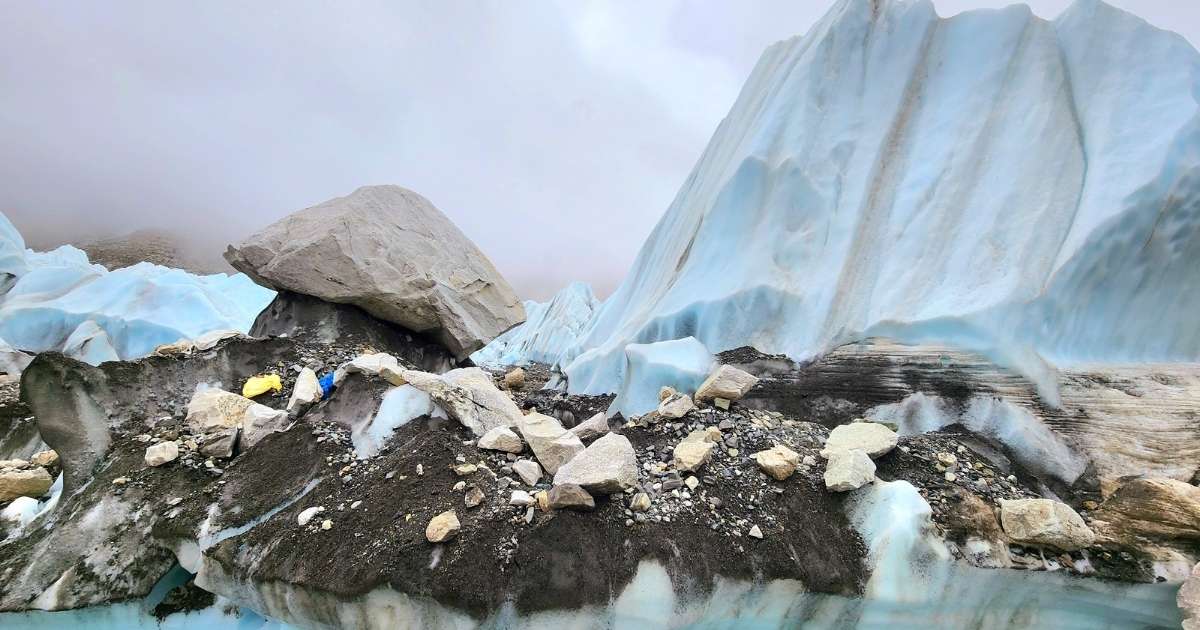
Everest Base Camp sits at an altitude of 5,364 meters (17,598 feet) on the Khumbu Glacier in Nepal. Although many people expect panoramic views of Mount Everest, the summit isn’t actually visible from Base Camp; it’s hidden behind surrounding peaks. Instead, you’ll find the famous Everest Base Camp marker, colorful prayer flags, the dramatic Khumbu Icefall, and, during the spring climbing season, a vibrant tent city used by Everest expeditions.
There are no hotels, restaurants, teahouses, or permanent facilities at Everest Base Camp, so most trekkers spend one to two hours there before returning to Gorak Shep. For the best view of Mount Everest, most continue to Kala Patthar (5,545 m / 18,192 ft), widely regarded as the best viewpoint in the Everest region.
What Is Everest Base Camp Really Like?
Everest Base Camp is far different from what many first-time trekkers expect. Located at 5,364 meters on the Khumbu Glacier, it isn’t a village or permanent campsite but a rocky, constantly shifting glacier surrounded by some of the highest mountains in the world. There are no hotels, restaurants, shops, or permanent toilets here. The nearest teahouses are back in Gorak Shep.
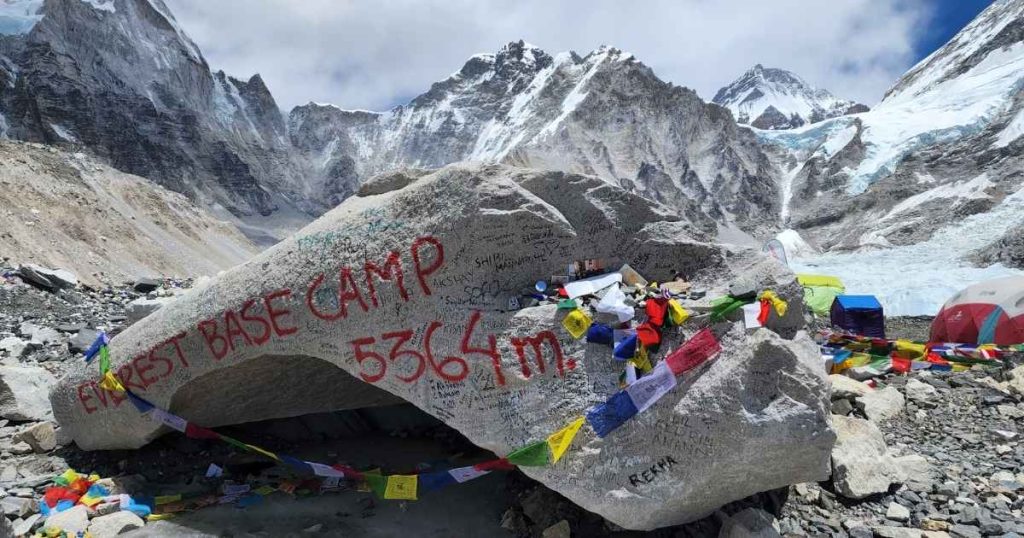
One of the biggest surprises for first-time trekkers is that you can’t actually see the summit of Mount Everest from Base Camp. Nearby peaks block the view, so the famous panorama of Everest is seen from Kala Patthar, not Base Camp itself. Instead, what you’ll find is the iconic Everest Base Camp marker, colorful prayer flags, and the dramatic Khumbu Icefall. During the spring climbing season, the glacier comes alive with hundreds of expedition tents preparing for summit attempts; outside the climbing season, it’s a much quieter place, with only trekkers stopping to celebrate before returning to Gorak Shep.
If you’d like to see the scenery before your trek, watch our Everest Base Camp video to experience the Khumbu Icefall, the famous Base Camp marker, colorful prayer flags, and the unique glacier landscape.
Watch Everest Base Camp Come to Life
Photos only tell part of the story. Watch the short video below to experience what Everest Base Camp really looks like, including the famous Base Camp marker, colorful prayer flags, the Khumbu Icefall, and the surrounding Himalayan landscape.
| What You Might Expect | What You’ll Actually Find |
| View of Mount Everest’s summit | The summit isn’t visible from Base Camp |
| Hotels, teahouses, or cafés | None. The nearest teahouses are in Gorak Shep |
| Toilets | No permanent toilets for trekkers |
| Everest Base Camp marker | The famous prayer flag-covered boulder |
| Expedition tents | Present only during the spring climbing season |
| Mobile signal & Wi-Fi | Limited and unreliable |
| Overnight accommodation | Trekkers return to Gorak Shep |
The simplicity of Everest Base Camp is part of what makes it so memorable. There are no permanent buildings, restaurants, or tourist facilities, just the glacier, the Khumbu Icefall, and some of the highest mountains on Earth surrounding you. Most trekkers spend one to two hours taking photos, soaking in the atmosphere, and celebrating this incredible achievement before hiking back to Gorak Shep.
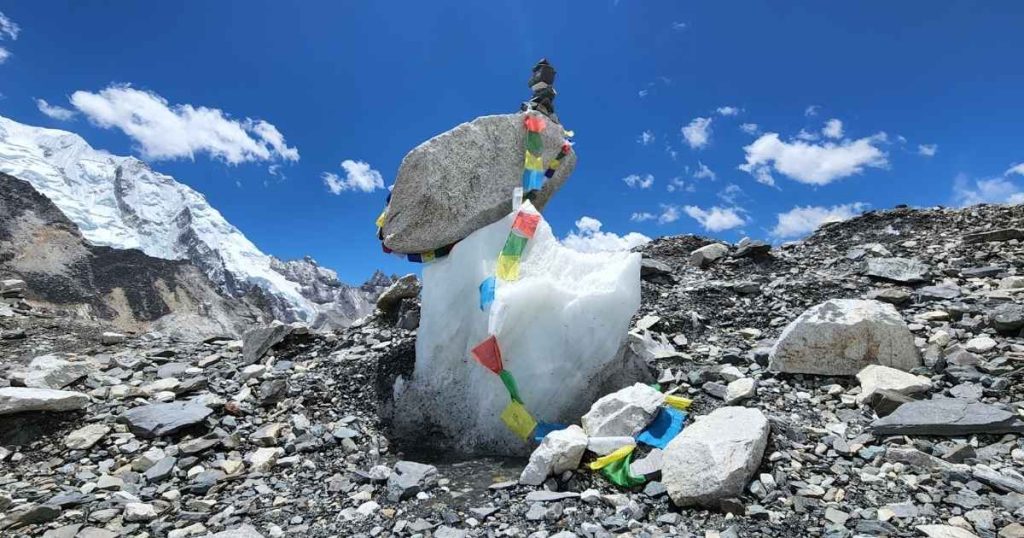
Where Is Everest Base Camp Located?
Everest Base Camp is located on the Khumbu Glacier within Sagarmatha National Park in northeastern Nepal, at the base of the Khumbu Icefall, the massive glacier that Everest climbers must cross on their way to the summit.
Unlike a village or permanent settlement, Everest Base Camp is a temporary campsite located on the slowly moving Khumbu Glacier. Its exact location shifts slightly from year to year as the glacier moves and climbing expeditions establish their camps each spring.
The nearest settlement, Gorak Shep (5,164 m / 16,942 ft), is the final overnight stop for trekkers and lies about 3.5 km (2.2 miles) one way from Base Camp, roughly a 2 to 3-hour hike. Since Base Camp has no teahouses or permanent facilities, all trekkers return to Gorak Shep after their visit.
The final section of the trail crosses rocky glacial moraine, with uneven boulders, loose gravel, and patches of ice underfoot. Arriving at Base Camp, surrounded by towering Himalayan peaks and the dramatic Khumbu Icefall, is one of the most memorable moments of the entire trek.
Can You See Mount Everest from Everest Base Camp?
The summit of Mount Everest is hidden behind the massive ridge of Nuptse and Everest’s western shoulder, a detail that surprises many first-time trekkers.
Instead, Everest Base Camp offers impressive views of the Khumbu Icefall, Nuptse, Pumori, Khumbutse, and Lingtren. Combined with the famous Everest Base Camp marker, colorful prayer flags, and the dramatic glacier landscape, the scenery is unforgettable even without a direct view of Everest’s summit.
For the classic panoramic view of Mount Everest, trekkers hike to Kala Patthar (5,545 m / 18,192 ft), usually early the following morning. From its summit, you’ll enjoy one of the most famous and unobstructed views of Everest in the entire Khumbu region. Our detailed Kala Patthar Guide covers everything you need to know before the hike.
| Feature | Everest Base Camp | Kala Patthar |
| Altitude | 5,364 m | 5,545 m |
| View of Everest Summit | No | Yes |
| Main Highlights | Khumbu Icefall, Base Camp marker, expedition tents (spring), glacier scenery | Panoramic view of Mount Everest and surrounding peaks |
| Distance from Gorak Shep | Around 2–3 hours round trip | Around 2–3 hours round trip |
| Best Time to Visit | Late morning or midday | Sunrise or sunset |
Rather than choosing between the two, think of them as complementary experiences. Everest Base Camp is where you celebrate reaching your destination, while Kala Patthar is where you enjoy the best view of Mount Everest. Most standard Everest Base Camp itineraries include both.

What Is the Khumbu Icefall at Everest Base Camp?
One of the most spectacular sights from Everest Base Camp is the Khumbu Icefall, a constantly moving section of the Khumbu Glacier that marks the beginning of the climbing route to the summit of Mount Everest. Towering ice towers (called seracs), deep crevasses, and shifting blocks of ice make it one of the most technically challenging and dangerous parts of any Everest expedition.
Trekkers don’t enter the Khumbu Icefall, but you can admire it from a safe distance at Everest Base Camp. During the spring climbing season, you may even see climbers and Sherpa teams preparing to cross the Icefall using ladders and fixed ropes on their way to higher camps.
| Feature | Details |
| Location | Above Everest Base Camp on the Khumbu Glacier |
| Who uses it? | Everest climbers and Sherpa teams |
| Can trekkers enter it? | No |
| Why is it famous? | It’s the first major obstacle on the route to the summit of Mount Everest |
| Best time to see activity | Spring (April–May) climbing season |
What Does the Altitude Feel Like at Everest Base Camp?
At 5,364 meters, the air at Everest Base Camp contains about half the oxygen available at sea level. Even if you’ve acclimatized properly, you’ll notice that even simple activities require more effort. You’ll walk more slowly, breathe more deeply, and may need a short rest after climbing a few steps or even bending down to tie your boots.
| At 5,364 m | What Most Trekkers Experience |
| Breathing | Faster and deeper than at lower elevations |
| Walking | A slower pace with more frequent rest stops |
| Energy | Even simple activities feel more tiring |
| Common Symptoms | Mild headache, reduced appetite, and disturbed sleep |
| Temperature | Cold, especially in the wind and early morning |
| Best Approach | Walk slowly, stay hydrated, eat regularly, and listen to your guide |
Mild headaches, a reduced appetite, and difficulty sleeping are common at this altitude, even for healthy trekkers. This is why the standard Everest Base Camp itinerary includes two acclimatization days in Namche Bazaar and Dingboche, giving your body time to adjust before reaching Everest Base Camp.
The best way to cope with the altitude is to trek at a steady pace, drink plenty of water, eat regular meals, and let your guide know if you develop any symptoms. If you’d like to learn more about the symptoms, prevention, and treatment of altitude sickness, read our Everest Base Camp Altitude Sickness Guide.
Cold temperatures are another challenge. Even on sunny days, Everest Base Camp can feel surprisingly cold, especially when the wind picks up. The early morning hike to Kala Patthar is often the coldest part of the entire trek, with temperatures well below freezing. Wearing proper layers, an insulated jacket, warm gloves, and other cold-weather gear will make the experience much more comfortable. For a complete checklist, see our Everest Base Camp Packing List.
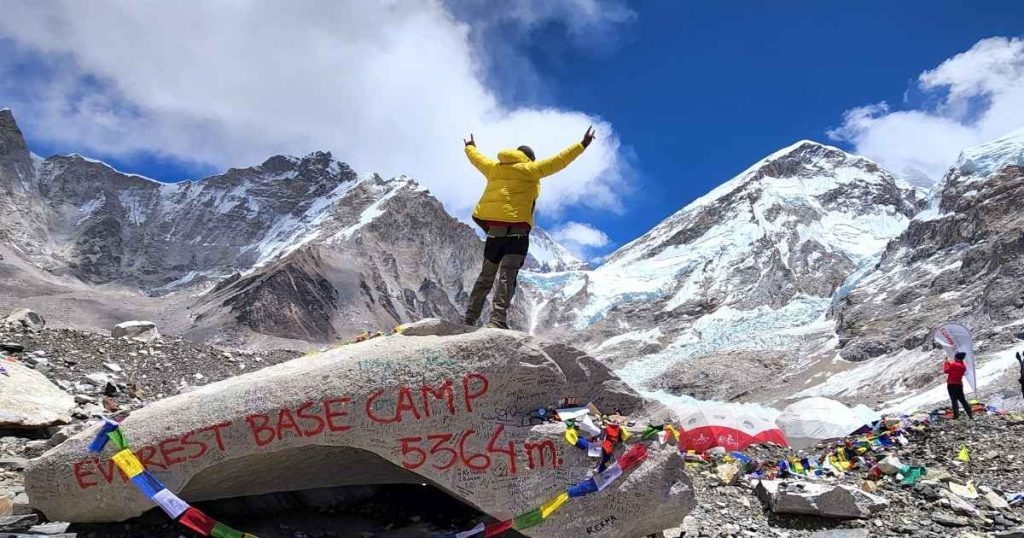
What Is Everest Base Camp Like in Different Seasons?
Everest Base Camp offers a different experience depending on the time of year you visit. During the spring climbing season (April to May), the glacier comes alive with colorful expedition tents, climbers preparing for summit attempts, and support teams working around the clock. It’s the only time trekkers can see a fully operational Everest expedition Base Camp.
In autumn (October and November), the expedition tents are gone, leaving behind a quieter and more peaceful landscape. You’ll still see the famous Everest Base Camp marker, prayer flags, the Khumbu Icefall, and spectacular mountain scenery, but without the activity of climbing expeditions. Many trekkers enjoy the calm atmosphere and clearer mountain views during this season.
| Season | What Everest Base Camp Is Like |
| Spring (March–May) | Colorful expedition tents, climbing teams, and a lively atmosphere. The busiest season for Everest expeditions. |
| Summer/Monsoon (June–August) | Fewer trekkers, cloudy skies, frequent rain at lower elevations, and limited mountain views. |
| Autumn (September–November) | Clear mountain views, no expedition camps, pleasant trekking conditions, and a quieter Base Camp. |
| Winter (December–February) | Very cold temperatures, fewer trekkers, snow-covered landscapes, and a peaceful atmosphere. |
Spring is the only season when you’ll see Everest expedition camps at Base Camp. Autumn offers the best combination of clear mountain views and quieter trails, while winter provides solitude for experienced trekkers. Monsoon is the least popular season because frequent clouds and rain often reduce visibility and make travel more challenging. For a detailed month-by-month breakdown, read our Best Time for the Everest Base Camp Trek guide.
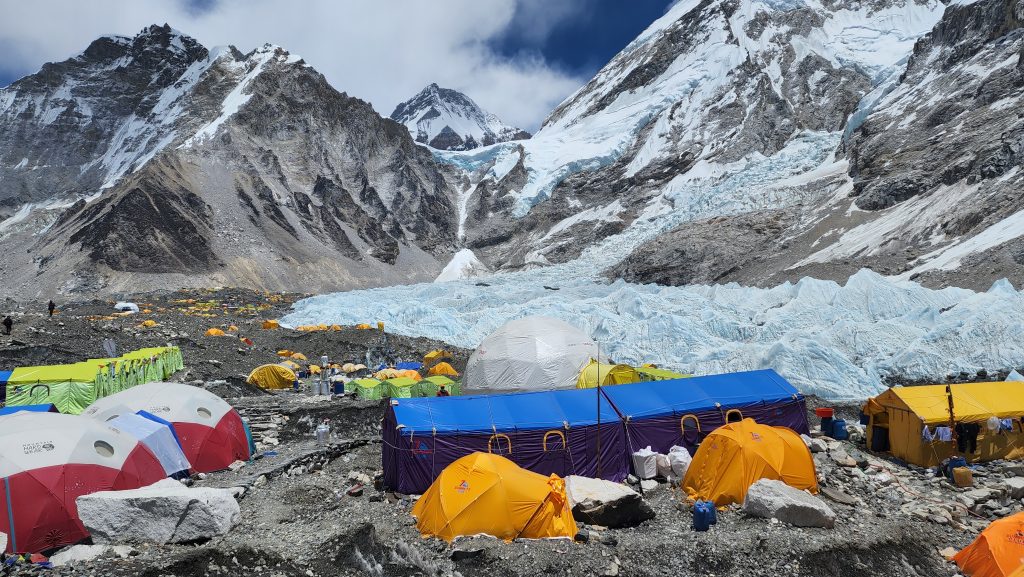
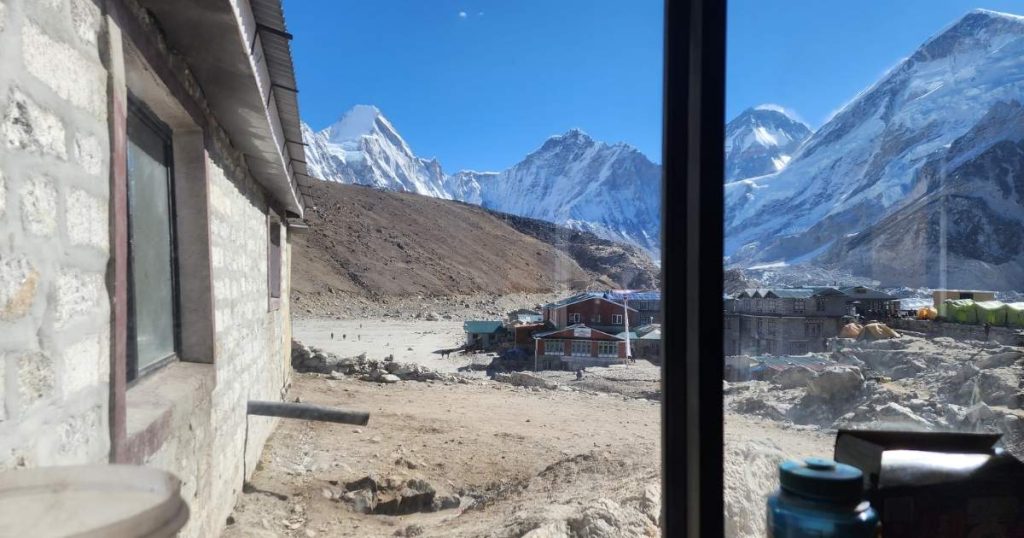
Facilities Near Everest Base Camp: Staying at Gorak Shep
After reaching Base Camp, most trekkers spend one to two hours taking photos and enjoying the surroundings before hiking back to Gorak Shep (5,164 m), the highest permanent settlement on the Everest Base Camp Trek.
Gorak Shep is where you’ll spend the night before or after visiting Base Camp. Although facilities are basic, you’ll find comfortable teahouses, hot meals, drinks, charging services, and limited Wi-Fi. Because every supply must be carried by porters, yaks, or helicopters, prices here are the highest anywhere along the Everest Base Camp Trek.
| Facility | Typical Cost (NPR) |
| Twin-sharing room | 1,000–1,500 |
| Dal Bhat | 1,000–1,500 |
| Noodles or Fried Rice | 800–1,200 |
| Tea or Coffee | 300–600 |
| 1 L Boiled Drinking Water | 300–500 |
| Soup | 600–1,000 |
| Device Charging | 500–800 per device |
| Wi-Fi | 700–1,000 |
Don’t expect luxury at Gorak Shep. Rooms are simple, nights are cold, and facilities are limited because of the high altitude and remote location. Even so, sharing a warm meal in the teahouse after reaching Everest Base Camp is an unforgettable part of the experience.
If you’d like a detailed guide to accommodation, food, internet, and other facilities along the route, see our Everest Base Camp Accommodation, Everest Base Camp Food, and Internet & Wi-Fi on the Everest Base Camp Trek guides.
The Walk from Gorak Shep to Everest Base Camp
The hike from Gorak Shep to Everest Base Camp is the final stage of the trek and one of the most memorable. Although the one-way distance is only about 3.5 km (2.2 miles), the high altitude and rocky glacier terrain make it feel much longer than the map suggests.
Most trekkers take 2 to 3 hours to reach Everest Base Camp from Gorak Shep and 1.5 to 2 hours to return. The trail follows the edge of the Khumbu Glacier, crossing rocky moraine with several short climbs and descents. At over 5,300 meters, even gentle uphill sections require extra effort because of the thin air.
| Route Information | Details |
| Starting Point | Gorak Shep (5,164 m / 16,942 ft) |
| Destination | Everest Base Camp (5,364 m / 17,598 ft) |
| One-Way Distance | About 3.5 km (2.2 miles) |
| Hiking Time | 2–3 hours each way |
| Trail Difficulty | Moderate to challenging due to altitude |
| Terrain | Rocky moraine and glacier trail |
Most trekking groups leave Gorak Shep in the late morning or around midday after checking into their teahouse. After spending one to two hours at Everest Base Camp for photos and to enjoy the scenery, they return to Gorak Shep before late afternoon, where they spend the night before hiking to Kala Patthar the following morning.
Carry enough water, sunscreen, sunglasses, and warm layers in your daypack. Weather can change quickly at this altitude, and temperatures often drop as the afternoon progresses. Trekking poles are also helpful on the uneven rocky trail.
Where Does Everest Base Camp Fit in the Trek Itinerary?
| Day of Visit | Usually, Day 9 |
| Overnight Stay | Gorak Shep |
| Return After Visit | Back to Gorak Shep |
| Next Morning | Kala Patthar sunrise hike |
| Full Itinerary | See our Everest Base Camp Itinerary guide |
Make the Most of Your Time at Everest Base Camp
Most trekkers spend between one and two hours at Everest Base Camp before returning to Gorak Shep. Here’s how to make the most of your visit.
| Tip | Why It Matters |
| Take your photos early | The famous Everest Base Camp marker can get busy during peak season. |
| Dress warmly | Even on sunny days, it can be cold and windy at 5,364 meters. |
| Stay hydrated | The high altitude increases the risk of dehydration. |
| Don’t rush | Take time to enjoy the Khumbu Icefall, prayer flags, and glacier scenery. |
| Respect expedition camps | During spring, avoid entering climbers’ camps unless invited. |
| Save energy for the return | You’ll still need to hike back to Gorak Shep, and many trekkers climb Kala Patthar the next morning. |
Spending a little extra time appreciating the surroundings often becomes one of the most memorable parts of the trek. After taking your photos, pause for a few minutes to enjoy the atmosphere, watch the Khumbu Icefall, and celebrate reaching one of the world’s most iconic trekking destinations.
Frequently Asked Questions About Everest Base Camp
1. What is the altitude of Everest Base Camp? Everest Base Camp sits at 5,364 meters (17,598 feet) above sea level on the Khumbu Glacier in Nepal. Most trekkers spend one to two hours at Base Camp before returning to Gorak Shep (5,164 m), the nearest place with teahouses.
2. Can you see Mount Everest from Everest Base Camp? No. The summit is hidden behind Nuptse and Everest’s western shoulder. For the best panoramic view of Everest, most trekkers hike to Kala Patthar (5,545 m) the following morning.
3. What will I actually see at Everest Base Camp? The famous Everest Base Camp marker, colorful prayer flags, the impressive Khumbu Icefall, and surrounding peaks such as Nuptse and Pumori. During the spring climbing season, you’ll also see expedition tents spread across the glacier.
4. How long do trekkers spend at Everest Base Camp? Most trekkers spend one to two hours at Everest Base Camp taking photos, enjoying the scenery, and celebrating before hiking back to Gorak Shep.
5. Can trekkers stay overnight at Everest Base Camp? No. Standard trekkers stay overnight in Gorak Shep. Overnight stays at Base Camp are generally reserved for Everest climbing expeditions with special permits.
6. How difficult is the hike from Gorak Shep to Everest Base Camp? The hike covers about 3.5 km (2.2 miles) each way and usually takes 2–3 hours. While the distance is relatively short, the high altitude and uneven glacier terrain make it one of the most challenging parts of the trek.
7. Is Everest Base Camp safe? Yes. The trek is considered safe for most healthy people when completed with proper acclimatization, an experienced guide, and a sensible pace. The biggest risk is altitude sickness, which is why acclimatization days are included in the standard itinerary.
8. When is the best time to visit Everest Base Camp? The best seasons are spring (March–May) and autumn (September–November). Spring offers blooming rhododendrons and Everest expedition camps, while autumn usually brings clear skies and excellent mountain views.
9. How cold is Everest Base Camp? Temperatures often fall below freezing, especially at night and during the early morning. Wind can make it feel even colder, so warm layers, gloves, and an insulated jacket are essential.
10. Is there mobile signal or Wi-Fi at Everest Base Camp? Mobile coverage is limited and unreliable. Some trekkers may receive a weak signal, but it shouldn’t be relied upon. Wi-Fi and charging facilities are available in Gorak Shep for an additional fee.
11. Is Everest Base Camp worth visiting if you can’t see the summit of Everest? Absolutely. Reaching Everest Base Camp is the highlight of the trek and offers incredible views of the Khumbu Icefall, surrounding Himalayan peaks, and the unique glacier landscape. The iconic view of Mount Everest itself comes from nearby Kala Patthar, which most trekkers visit the following morning.
Is Everest Base Camp Worth Visiting?
Everest Base Camp is one of the world’s most rewarding trekking destinations, but it’s often different from what first-time visitors expect. Instead of a summit view or permanent facilities, you’ll experience the dramatic Khumbu Glacier, the famous Everest Base Camp marker, the towering Khumbu Icefall, and the satisfaction of reaching one of the highest trekking destinations on Earth.
With proper preparation, a realistic itinerary, and enough time to acclimatize, visiting Everest Base Camp is an achievable goal for many trekkers. Knowing what to expect before you arrive will help you enjoy the experience even more.
If you’re ready to experience Everest Base Camp for yourself, our trek follows the classic route with experienced local guides, proper acclimatization, and carefully planned itineraries. Explore the full itinerary, departure dates, inclusions, and pricing on our Everest Base Camp Trek package page. If you have any questions, feel free to contact us. We’re always happy to help you plan your adventure.