Flying to Lukla is the fastest and most popular way to start the Everest Base Camp trek. The flight takes less than an hour and gives you some of the best mountain views you’ll ever see from a plane, but mountain weather is unpredictable, so delays and cancellations happen often. Build at least one extra day into your itinerary and avoid booking an international flight home right after your trek ends.
Planning to trek after your flight? Our Everest Base Camp Trek Package guide covers everything you need to know, including the day-by-day itinerary, current pricing, permits, accommodation, what’s included, and practical tips to help you prepare for your adventure.
Quick Summary
- The flight takes 30–35 minutes from Kathmandu or 15–20 minutes from Ramechhap.
- A one-way ticket costs around USD 251 from Kathmandu or USD 208 from Ramechhap.
- Spring (March–May) and autumn (September–November) offer the most reliable flights and clearest views.
- Delays and cancellations are common due to weather, so always keep a buffer day before any international flight home.
- Lukla Airport is technically demanding, not unsafe. Flights only operate when strict weather and visibility conditions are met.
Quick Facts: Lukla Flight & Airport
| Topic | Answer |
| Official Name | Tenzing-Hillary Airport |
| Location | Lukla, Solukhumbu District, Nepal |
| Departure Airport | Kathmandu (off-season) or Ramechhap (peak season) |
| Flight Duration | 30–35 min from Kathmandu, 15–20 min from Ramechhap |
| Typical Price | Kathmandu–Lukla: USD 251 one way; Ramechhap–Lukla: USD 208 one way |
| Airport Elevation | 2,860 m (9,383 ft) |
| Runway Length | 527 m (1,729 ft), paved, uphill slope |
| Airport Opened | 1964, built under Sir Edmund Hillary’s initiative |
| Best Time to Fly | Spring (Mar–May) and autumn (Sep–Nov) |
| Common Delays | Weather, low visibility, air traffic |
| If cancelled | Wait for next flight, take a helicopter, or drive via Salleri/Surke |
Where Is Lukla Airport?
Lukla Airport, officially Tenzing-Hillary Airport, sits in the small mountain town of Lukla in Nepal’s Solukhumbu District, in the Khumbu (Everest) region, at 2,860 meters (9,383 feet). It’s the main gateway to the Everest Base Camp Trek, as well as popular routes such as Gokyo Lakes Trek, Mera peak climbing and many more other destinations.
Lukla has no road connection to Kathmandu, so almost everyone gets there by a short domestic flight. The airport opened in 1964 under Sir Edmund Hillary’s initiative to improve access to the Everest region, and was later renamed to honor Hillary and Tenzing Norgay, the first two people confirmed to summit Everest in 1953. Today it handles thousands of trekkers a year and is the real starting point of most EBC adventures.
Kathmandu vs. Ramechhap Flights to Lukla: Which Airport Will You Fly From?
Most off-season flights leave from Kathmandu, but during spring and autumn, most flights shift to Ramechhap to ease congestion at Kathmandu’s airport.
Your departure point depends entirely on the season. Lukla flights can only operate in the early morning while the weather is stable, so when Kathmandu’s Tribhuvan International Airport gets too busy with domestic and international traffic during peak trekking months, airlines move Lukla flights to Ramechhap (Manthali Airport) instead. This lets more flights get out before the weather turns.
| Factor | Kathmandu | Ramechhap |
| Flight Time | 30–35 min | 15–20 min |
| Peak Season | Limited flights | Main departure point |
| Off-Season | Most flights | Few or none |
| Extra Drive Needed | No | Yes, 4–5 hrs from Kathmandu |
| Convenience | Higher | Lower |
| Best For | Off-season travelers | Spring & autumn trekkers |
If your flight departs from Ramechhap, expect to leave Kathmandu around 2–3 AM for the drive to Manthali before your morning flight. It’s an early start, but the airport is less crowded and the flight itself is shorter. Kathmandu is more convenient if you have the choice, but there’s nothing to worry about if you get assigned to Ramechhap. It’s well organized and just as safe.
How Long Is the Flight to Lukla?
The flight takes 30–35 minutes from Kathmandu and 15–20 minutes from Ramechhap.
| Topic | Answer |
| Kathmandu → Lukla | 30–35 minutes |
| Ramechhap → Lukla | 15–20 minutes |
| Best Seat (To Lukla) | Left side of the aircraft |
| Best Seat (Return) | Right side of the aircraft |
| Best Time to Fly | Early morning for the clearest weather and views |
| Highlights | Himalayan peaks, deep valleys, Sherpa villages, terraced farmland |
Short as it is, the flight is one of the most memorable parts of the trip. On a clear day you’ll see snow-capped Himalayan peaks, winding river valleys, Sherpa villages, and terraced hillsides before landing right in the heart of the Everest region. Seating on these small STOL aircraft is usually assigned by weight distribution rather than preference, so a window seat isn’t guaranteed, though it doesn’t hurt to ask politely at check-in. Keep your camera or phone within reach before takeoff. The best views can appear at any point during the flight, especially on clear mornings.
Lukla Airport Specs and Why It’s So Difficult to Land
Lukla Airport is considered one of the world’s most technically demanding airports because of its short, uphill runway and steep mountain terrain on every side.
| Feature | Details |
| ICAO Code | VNLK |
| IATA Code | LUA |
| Elevation | 2,860 m (9,383 ft) |
| Runway Length | 527 m (1,729 ft) |
| Runway Surface | Asphalt |
| Runway Slope | About 12% uphill |
| Opened | 1964 |
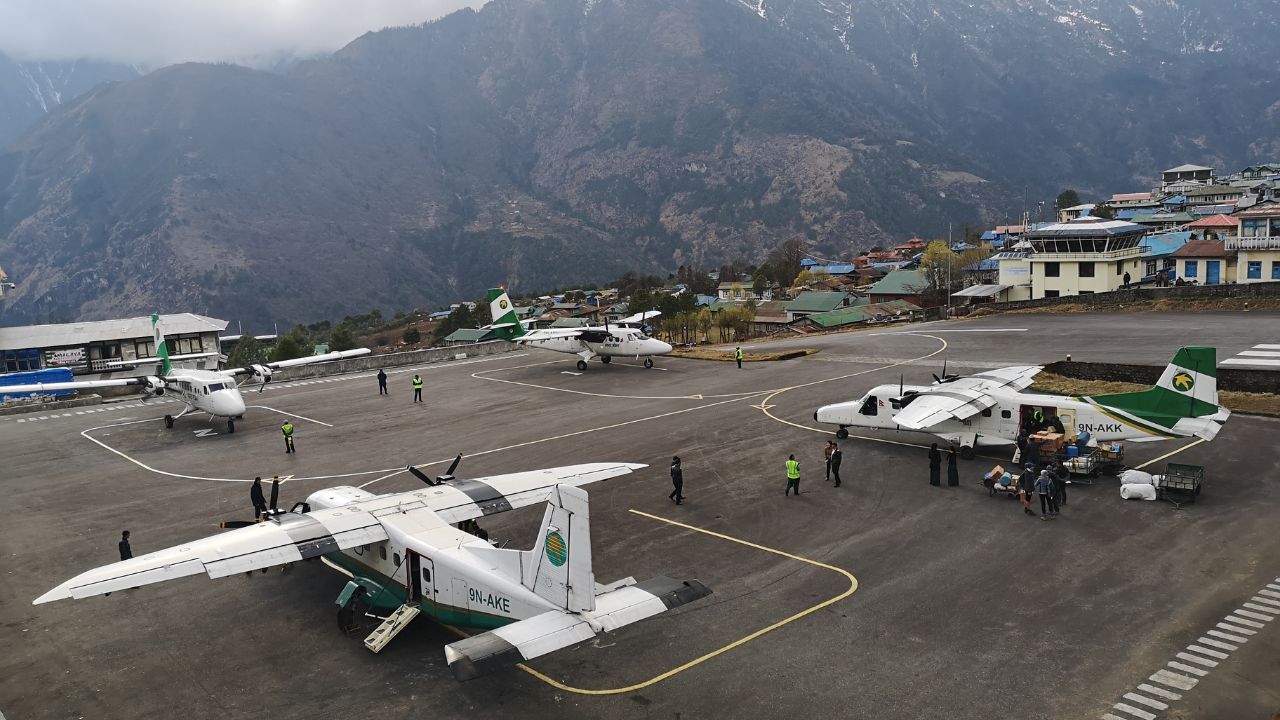
Unlike a normal airport built on flat ground, Lukla sits on a mountainside with a steep drop at one end and rising terrain at the other. The uphill slope helps planes slow down after landing and gives them extra push during takeoff in the opposite direction. There’s no room to circle back for a second landing attempt, so flights only happen when the weather clearly meets safety limits. If cloud cover or visibility drops below that threshold, the flight simply waits or gets cancelled.
Only pilots with specific mountain flying experience and Short Takeoff and Landing (STOL) qualifications are allowed to fly this route, and they go through additional training before they’re cleared for it.
Which Airlines Fly to Lukla?
Three domestic carriers run scheduled STOL flights to Lukla: Summit Air, Tara Air, and Sita Air, all using small twin-engine aircraft built for short mountain runways.
| Airline | Aircraft | Typical Departure |
| Summit Air | Dornier 228 | Kathmandu or Ramechhap |
| Tara Air | Twin Otter DHC-6-300 | Kathmandu or Ramechhap |
| Sita Air | Dornier 228 | Kathmandu or Ramechhap |
The Twin Otter DHC-6-300 is the most common aircraft on this route because of its short takeoff and landing performance, while the Dornier 228 is the other main option used across Nepal’s remote airstrips. Both carry 15–19 passengers.
All three airlines follow the same aviation regulations and use approved mountain aircraft, so there isn’t a meaningful difference in safety or service between them. Which one you fly usually comes down to your trekking agency or seat availability rather than a real choice you get to make. If you’re booking through an agency, the flight is often included in your package, and the specific airline is sometimes only confirmed close to your departure date.
How Much Does a Lukla Flight Cost?
A one-way ticket from Kathmandu costs about USD 251, and from Ramechhap about USD 208. Nepali citizens pay a lower domestic fare.
If you’re planning your overall budget, don’t forget that the flight is only one part of the total trip cost. Our Everest Base Camp Trek Cost guide breaks down everything you’ll need to budget for, including permits, accommodation, meals, guide and porter fees, transportation, gear, and optional expenses, helping you estimate the full cost of your Everest adventure.
| Flight Type | Typical Price |
| Kathmandu → Lukla | USD 251 one way |
| Ramechhap → Lukla | USD 208 one way |
| Nepali Citizen Fare | Lower domestic rate, varies by airline |
| Shared Helicopter | USD 500–600 per person |
| Private Helicopter Charter | USD 2,500–3,000 per flight |
A standard ticket includes the one-way flight, airport taxes, and a standard baggage allowance. It does not include meals, travel insurance, or excess baggage fees. Prices can change without notice, especially for helicopter charters, which shift with season and demand.
If you’re trekking in spring or autumn, book several weeks or months ahead since seats sell out fast. If you’re going through a trekking company, your flight is usually arranged and included in the package before you even land in Nepal.
Best Month and Time to Fly to Lukla
April, May, October, and November are the best months to fly to Lukla. These months usually offer the most stable weather, the clearest mountain views, and the highest chance of flights operating on schedule. Although Lukla flights operate throughout the year, weather in the Himalayas can change rapidly, so it’s always wise to include at least one extra day in your itinerary in case of delays.
Choosing the right month to fly is closely linked to choosing the best season for your trek. If you’re still deciding when to visit, our Best Time for Everest Base Camp Trek guide compares every month of the year, covering weather, temperatures, trail conditions, crowds, visibility, and the pros and cons of each season so you can plan the trip that suits you best.
Best Seasons to Fly
| Season | Reliability | Weather |
| Spring (Mar–May) | Excellent | Clear mornings, mild temperatures, excellent visibility |
| Autumn (Sep–Nov) | Excellent | Dry weather, crisp skies, outstanding mountain views |
| Winter (Dec–Feb) | Good | Cold but often clear, with occasional fog or snowfall |
| Monsoon (Jun–Aug) | Poor | Heavy rain, cloud cover, low visibility |
Best Time of Day to Fly
Lukla flights are almost always scheduled early in the morning because weather conditions are generally calmest shortly after sunrise. As the day warms, valley winds become stronger, clouds build over the mountains, and visibility often decreases. This is why afternoon flights to Lukla are rare.
| Time | Conditions | Reliability |
| 6–8 AM | Calm, clear skies | Best |
| 8–10 AM | Mostly clear | Very Good |
| 10 AM–12 PM | More cloud, stronger winds | Fair |
| After 12 PM | Low cloud, poor visibility | Uncommon |
Lukla Airport operates under visual flight rules (VFR), so pilots need adequate visibility to safely approach and land. If weather conditions fall below operational limits, flights are delayed or cancelled until conditions improve.
Tip: Whenever possible, choose the earliest flight of the day. Early departures usually provide the smoothest flying conditions, the clearest Himalayan views, and the highest chance of operating on schedule.
Why Are Lukla Flights Delayed So Often?
Lukla flights get delayed mainly because of low clouds and poor visibility, since the airport has no instrument landing system and pilots need a clear visual approach to land safely.
| Cause | Effect |
| Low clouds | Blocks visibility around the airport and mountains |
| Poor visibility | Pilots need clear visual conditions to take off and land |
| Strong winds | Makes flight operations unsafe |
| Rain | Often brings low cloud with it |
| Snow | Can suspend operations entirely |
| Air traffic | Peak-season congestion delays departures |
Even if the weather looks fine in Kathmandu or Ramechhap, conditions at Lukla itself might still ground flights. Delays are most common during monsoon season, though they can happen in spring and autumn too, usually clearing up once the morning weather improves. This is also why most flights are scheduled early: mountain weather tends to be calmest right after sunrise.
A delay doesn’t necessarily mean a cancellation. Conditions in the Himalayas can shift quickly, and flights often resume later the same morning.
What Happens If Your Lukla Flight Gets Cancelled?
If your flight is cancelled, your airline will typically try to rebook you on the next available flight, or you can switch to a helicopter or drive to Surke and trek in from there.
| Option | What It Means |
| Wait for the next flight | Airline rebooks you as space allows |
| Join a shared helicopter | Split the cost with other trekkers |
| Book a private helicopter | Fastest option, most expensive |
| Start by road | Drive to Salleri or Surke and trek in |
During busy seasons, seats on the next flight can be limited, so if bad weather drags on for several days, waiting times can stretch out too. If you’re with a tour operator, they’ll usually handle rebooking and help you find the fastest workable option.
A shared helicopter is often the best middle ground. It’s much cheaper than chartering your own, and it gets you moving again faster than waiting out the weather. Helicopters are still weather-dependent though, so they can be delayed too.
Keeping at least one buffer day in your itinerary before any international flight home is the single most useful thing you can do. This one habit saves more trekkers from missed connections than anything else on this list. Pair it with travel insurance that covers weather-related delays and evacuation.
Helicopter as a Lukla Flight Alternative
A helicopter is a faster but pricier alternative when your flight is delayed, cancelled, or fully booked, and unlike planes, it can sometimes fly in slightly rougher conditions, though it’s still weather-dependent.
| Feature | Regular Flight | Helicopter |
| Travel Time | 30–35 min | 45–60 min |
| Departure | Scheduled | On demand or shared charter |
| Cost | Lower | Higher |
| Best For | Most trekkers | Time-sensitive travelers |
A shared helicopter splits the charter cost among several passengers heading to the same place, typically USD 500–600 per person. A private charter gives you the whole aircraft and full control over timing, usually USD 2,500–3,000 per flight.
Consider a helicopter if your flight’s been cancelled, you’re short on time, you need to catch an international connection, scheduled flights are sold out, or you’re in a small group that can split the cost. The tradeoffs are real: it costs significantly more, weather can still ground it, and shared flights sometimes require waiting until enough passengers sign up. If you’re trekking with a guide, ask them to help match you with other trekkers to fill a shared helicopter faster.
Baggage Allowance for Lukla Flights
All airlines flying to Lukla allow 10 kg (22 lbs) of checked baggage and 5 kg (11 lbs) of carry-on baggage, giving a total baggage allowance of 15 kg (33 lbs).
Typical Baggage Allowance
- Checked baggage (duffel bag): Up to 10 kg (22 lbs)
- Carry-on baggage: Up to 5 kg (11 lbs)
- Total baggage allowance: 15 kg (33 lbs)
If your luggage exceeds the 15 kg allowance, most airlines will allow a few extra kilograms for an additional charge of approximately USD 1–1.50 per kg (or the equivalent in Nepalese Rupees), provided the aircraft has sufficient weight capacity. However, because Lukla flights operate with small aircraft and strict weight limits, airlines may refuse excess baggage if the aircraft is already carrying its maximum allowable weight, even if you’re willing to pay the extra fee. In that case, you may need to leave some items in Kathmandu or have them sent on a later flight.
Packing Tips
- Wear your down jacket, hiking boots, and other heavy clothing during the flight to reduce baggage weight.
- Keep your passport, valuables, medication, electronics, and one change of clothes in your carry-on bag.
- Leave any items you won’t need during the trek at your hotel in Kathmandu.
- Pack your gear in a soft duffel bag rather than a hard suitcase, as it’s easier to load onto small aircraft and more comfortable for your porter to carry.
Good to know: The 15 kg baggage limit applies only to your Lukla flight. Once your trek begins, your porter can usually carry more gear, provided it stays within your trekking company’s porter policy (typically 20–25 kg per porter, shared between two trekkers).
What to Expect at Lukla Flight Check-In?
Check in at least 1 hour before departure with your passport (or valid ID) and your flight ticket. For Lukla flights, both you and your baggage are weighed to ensure the aircraft is properly balanced. After check-in, you’ll pass through security before waiting in the departure lounge for boarding announcements.
What Happens During Check-In?
- Present your passport (or valid ID) and printed or electronic flight ticket.
- Airport staff will weigh both you and your baggage to calculate the aircraft’s total weight and balance.
- Your checked baggage will be tagged and loaded separately.
- Complete the standard security screening before entering the departure lounge.
- Listen for boarding announcements, as departure gates may change depending on flight operations.
Being weighed is a normal part of flying to Lukla and helps ensure the safe operation of these small mountain aircraft. Because weather conditions can change quickly, it’s a good idea to arrive 1 hour before your scheduled departure, giving yourself plenty of time to complete check-in and security procedures.
Is Flying to Lukla Safe?
Yes. Lukla flights are operated by specially trained mountain pilots under strict safety regulations. Following several past accidents, aviation authorities introduced stronger operational procedures and weather requirements. Flights only operate when conditions are considered safe, and delays or cancellations are an important part of those safety measures.
| Safety Measure | How It Helps |
| Experienced pilots | Specially qualified for mountain and STOL flying |
| Strict weather rules | Flights only depart when visibility meets requirements |
| Morning scheduling | Weather is usually most stable early in the day |
| STOL aircraft | Twin Otter and Dornier built for short mountain runways |
| Regular maintenance | Routine inspections under aviation regulations |
Cancellations often get mistaken for a red flag, but they’re really a sign the system is working. When cloud cover, wind, or visibility drops below the safe threshold, airlines wait it out or cancel for the day rather than take a chance. For most trekkers, the real challenge isn’t the safety of the flight itself, it’s the possibility of a weather delay. A flexible itinerary with a buffer day is the best way to plan around that.
Why Is Lukla Called the World’s Most Dangerous Airport?
Lukla has earned this reputation because of its short runway, high elevation, and surrounding mountains, though there’s no official ranking that formally names it the most dangerous airport in the world. A handful of serious accidents over the decades have shaped this reputation:
| Year | Incident |
| 2004 | A Yeti Airlines Twin Otter crashed into Lamjura Hill on approach in poor visibility, killing all three crew members. |
| 2008 | Yeti Airlines Flight 103 crashed while landing in dense fog, killing 18 of the 19 people on board. |
| 2017 | A Summit Air cargo plane crashed short of the runway on final approach in poor visibility, killing both pilots. |
| 2019 | A Summit Air aircraft veered off the runway during takeoff and hit two parked helicopters, killing three people. |
Investigations into these accidents generally point to visibility and weather conditions rather than the airport’s design as the primary cause. After each incident, Nepal’s aviation authorities tightened training standards, operational procedures, and weather monitoring. What makes Lukla genuinely difficult is a combination of factors: a runway just 527 meters long, thinner air at 2,860 meters that reduces aircraft performance, mountain terrain that limits approach paths to a single direction, and weather that can shift in minutes. Pilots fly this route only after specialized STOL training, and they’d rather delay a flight than take an unnecessary risk.
Reaching Everest Without Flying to Lukla
If you’d rather avoid flying, or your Lukla flight is delayed or cancelled, you can still reach the Everest Base Camp trail by road. In recent years, improved mountain roads have made it possible to drive from Kathmandu to Salleri and continue by 4WD jeep to Surke, a village located just below Lukla. From Surke, you can begin trekking directly to Phakding, bypassing Lukla and joining the standard Everest Base Camp route.
Although this overland option takes longer than flying, it offers a more flexible alternative when weather disrupts flights and gives you a chance to experience more of Nepal’s countryside before entering the Everest region.
| Section | Distance | Travel Time |
| Kathmandu → Salleri | 265 km | 8–10 hrs by jeep or bus |
| Salleri → Surke | 35 km | 3–4 hrs by 4WD jeep |
| Surke → Phakding | 10 km | 4–5 hrs trekking |
From Surke, you don’t need to hike up to Lukla at all. Instead, you’ll follow the trail through Chaurikharka, Cheplung, and Ghat, joining the standard Everest Base Camp route at Phakding before continuing to Namche Bazaar, Tengboche, Dingboche, Lobuche, Gorak Shep, and finally Everest Base Camp.
Tips for a Smoother Lukla Flight
| Tip | Why It Matters |
| Book the earliest flight | Morning weather is usually the most stable |
| Keep a buffer day | Protects your international flight if you’re delayed |
| Pack a carry-on with essentials | Keep meds, valuables, and a change of clothes on you |
| Travel light | Stay within the baggage limit to avoid delays or fees |
| Check flight status before leaving | Weather can shift quickly |
| Carry some cash | For snacks, fees, or unexpected costs |
| Stay flexible | Delays are a normal part of mountain travel, not a bad sign |
Arrive at the airport 1–2 hours before departure, keep your passport and ticket handy, dress in layers, and charge your devices ahead of time. After your trek, don’t book your international flight home for the same day you’re scheduled to fly back from Lukla. Give yourself a cushion in Kathmandu in case weather pushes your return flight back.
Frequently Asked Questions About Lukla Flight
1. Is Lukla Airport safe?
Yes. Although Lukla Airport is one of the world’s most challenging mountain airports because of its short runway, high elevation, and surrounding terrain, flights are operated by pilots with specialized mountain and STOL (Short Takeoff and Landing) training. Airlines only fly when weather and visibility meet strict safety requirements, and delays are a sign that these safety procedures are working.
2. How long is the flight to Lukla?
The flight takes 30–35 minutes from Kathmandu and 15–20 minutes from Ramechhap (Manthali Airport). Although the journey is short, it offers spectacular views of the Himalayas. Keep in mind that weather-related delays often affect your travel time more than the flight itself.
3. Why are Lukla flights delayed so often?
Most delays are caused by low clouds, poor visibility, strong winds, rain, or snow. Because Lukla relies on visual flight operations, pilots need clear weather to land safely. Delays are most common during the monsoon season but can happen at any time of year.
4. Can I fly directly from Kathmandu to Lukla?
Yes. Direct flights usually operate from Kathmandu during the off-season. During the busy spring and autumn trekking seasons, however, many airlines temporarily move Lukla flights to Ramechhap (Manthali Airport) to reduce congestion at Kathmandu Airport.
5. What is the baggage limit for Lukla flights?
Most airlines allow 10 kg of checked baggage and 5 kg of carry-on baggage, for a total allowance of 15 kg. If your luggage exceeds the limit, you may need to pay an excess baggage fee or send it on a later flight if space is available.
6. What happens if my Lukla flight is cancelled?
If your flight is cancelled due to weather, you can wait for the next available flight, join a shared or private helicopter, or travel by road via Salleri and Surke to join the Everest Base Camp trail at Phakding. If you’re trekking with a tour operator, they will usually help arrange the best alternative.
7. Can I bring a drone to Lukla?
Yes, but you’ll need permission from the relevant aviation and tourism authorities before flying a drone in the Everest region. Regulations can change, so always check the latest requirements before your trip.
8. Should I take a helicopter instead of waiting for my flight?
A helicopter is a good alternative if your flight is cancelled, you’re short on time, or you need to catch an international connection. Shared helicopters are more affordable than private charters because the cost is split among passengers, but they are still weather-dependent.
9. Which side of the plane has the best mountain views?
For the best Himalayan views, try to sit on the left side of the aircraft when flying to Lukla and the right side on the return flight. Seating is usually assigned based on weight distribution, so a window seat cannot always be guaranteed.
10. Can I fly to Lukla during the monsoon season?
Yes. Flights continue to operate during the monsoon, but June through August has the highest chance of delays and cancellations because of heavy rain, cloud cover, and poor visibility. If you’re traveling during this period, allow extra buffer days in your itinerary.
11. How far in advance should I book a Lukla flight?
If you’re traveling during the spring or autumn trekking seasons, book your flight several weeks or even months in advance, as seats can sell out quickly. During the quieter months, flights are generally easier to book closer to your departure date.
12. What aircraft are used for Lukla flights?
Most scheduled Lukla flights use the De Havilland Canada DHC-6 Twin Otter and Dornier 228. These STOL (Short Takeoff and Landing) aircraft are specifically designed to operate safely on short mountain runways.
13. Are there daily flights to Lukla?
Yes. During the main trekking seasons, multiple flights operate each morning, weather permitting. In the off-season, fewer flights are scheduled because of lower demand, but flights continue throughout the year.
14. Is travel insurance recommended for Lukla flights?
Yes. Choose a travel insurance policy that covers flight delays, cancellations, and emergency helicopter evacuation in the Everest region. Before purchasing a policy, confirm that it also covers high-altitude trekking, as not all standard travel insurance plans include this.
15. How early should I arrive at the airport?
Plan to arrive 1–2 hours before your scheduled departure. This allows enough time for check-in, baggage screening, and any last-minute schedule updates. During peak trekking seasons, arriving early is especially important.
16. Can I book a Lukla flight without joining a trekking tour?
Yes. Independent travelers can book Lukla flights directly through domestic airlines, trekking agencies, or online booking platforms. However, if you’re joining an Everest Base Camp trekking package, your Lukla flights are usually arranged by your trekking company as part of the itinerary.
Ready to experience one of the world’s most scenic mountain flights? Explore our Everest Base Camp Trek packages, or browse our helpful planning guides below before your adventure begins.