If you’re deciding between Everest Base Camp vs Annapurna Base Camp trek, choose the Everest Base Camp Trek for iconic views of Mount Everest and a high-altitude adventure. Choose the Annapurna Base Camp Trek for a shorter, more affordable journey through diverse landscapes and traditional mountain villages.
Choosing between the Everest Base Camp (EBC) Trek and the Annapurna Base Camp (ABC) Trek depends on your fitness, budget, available time, and the type of adventure you’re looking for. While both offer spectacular Himalayan scenery, they provide distinctly different trekking experiences.
The Everest Base Camp Trek takes you through the legendary Khumbu region, where you’ll trek among Sherpa villages, ancient monasteries, and breathtaking views of Mount Everest.
The Annapurna Base Camp Trek follows a diverse trail through terraced fields, rhododendron forests, and traditional Gurung and Magar villages before reaching the spectacular Annapurna Sanctuary, surrounded by towering Himalayan peaks.
Whether you’re planning your first trek in Nepal or choosing between these two iconic routes, this guide will help you find the trek that best matches your travel goals, fitness level, and budget.
Choose Everest Base Camp if you:
- Dream of standing beneath Mount Everest, the world’s highest mountain
- Have 12 to 14 days available
- Are prepared for higher altitude and a more demanding trek
- Want to experience Sherpa culture and visit places like Namche Bazaar and Tengboche
Choose Annapurna Base Camp if you:
- Prefer a shorter trek, done in 7 to 11 days
- Want lower altitude and less risk of altitude sickness
- Have a smaller budget
- Enjoy varied scenery, including forests, waterfalls, villages, and the Himalayas
Neither trek is “better” overall. Both deliver world-class Himalayan scenery, warm teahouses, and an unforgettable trip. The right pick simply depends on your goals, budget, fitness, and time.
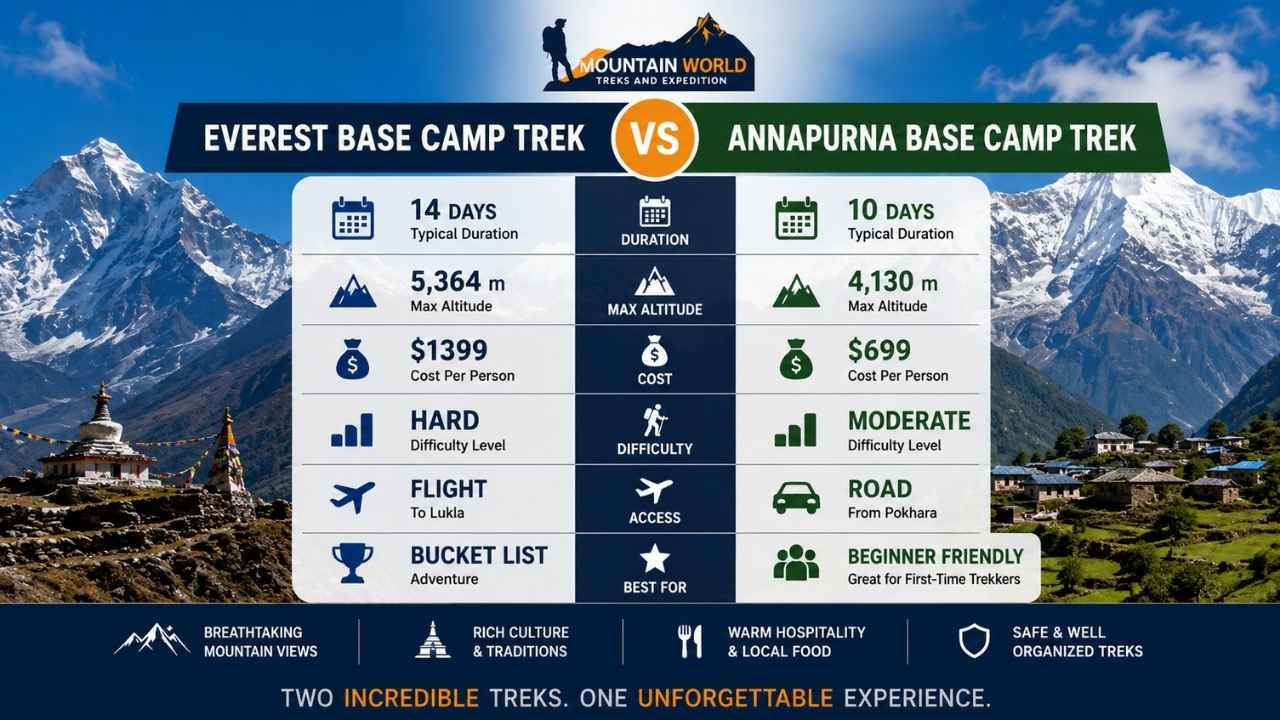
EBC vs ABC at a Glance
| Feature | Everest Base Camp | Annapurna Base Camp |
| Duration | 12 to 14 days | 7 to 11 days |
| Max altitude | 5,364 m | 4,130 m |
| Highest point | 5,545 m (Kala Patthar) | 4,130 m (Base Camp) |
| Trek distance | 130 km round trip | 70 to 80 km round trip |
| Difficulty | Moderate to challenging | Moderate |
| Access | Flight to Lukla | Drive from Pokhara |
| Altitude sickness risk | Higher | Moderate |
| Typical cost | Higher | Lower |
| Best for | Bucket-list adventure | First Himalayan trek |
Planning either trek? Compare our detailed Everest Base Camp Trek and Annapurna Base Camp Trek packages for full itineraries, inclusions, and pricing.
Expert Insight from Saligram Aryal: At Mountain World Treks, I’ve guided trekkers on both the Everest Base Camp and Annapurna Base Camp routes for more than 30 years. One thing we’ve learned is that there isn’t a single “best” trek for everyone. Travelers with limited time or a smaller budget often finish the Annapurna Base Camp Trek saying it exceeded their expectations, while those whose lifelong dream is to stand beneath Mount Everest almost never regret choosing the Everest Base Camp Trek, even though it’s more challenging. The best choice depends on your fitness, budget, available time, and the experience you’re looking for.
Everest Base Camp vs Annapurna Base Camp: Which Trek Is Difficult?
Everest Base Camp is the harder trek. It’s longer, climbs much higher, and demands more endurance. Annapurna Base Camp is still a real mountain trek, but its lower elevation and shorter itinerary make it more manageable for many first-timers.
| Factor | Everest Base Camp | Annapurna Base Camp |
| Difficulty | Moderate to challenging | Moderate |
| Duration | 12 to 14 days | 7 to 11 days |
| Max altitude | 5,364 m | 4,130 m |
| Highest sleeping altitude | 5,164 m (Gorak Shep) | 4,130 m |
| Daily walking | 5 to 7 hours | 4 to 6 hours |
| Altitude sickness risk | Higher | Moderate |
Why EBC is more demanding:
- Thinner air at higher altitude raises the risk of altitude sickness
- The longer trek requires more overall endurance
- Several days involve long, steep, rocky climbs
- Cold temperatures at higher elevation add to the strain
- Proper acclimatization is essential, not optional
Why ABC is easier:
- Its highest point is over 1,200 meters lower than EBC’s
- The shorter itinerary fits into a normal holiday
- Higher oxygen levels reduce altitude-related risk
- Daily walking distances tend to be shorter
- Road access gives you more flexibility if plans change
That said, ABC is not a walk in the park. Expect several days of uphill and downhill walking, thousands of stone steps, and changing weather. A reasonable fitness level still matters, but most healthy people who prepare beforehand finish it comfortably.
Want the ultimate high-altitude challenge? Everest Base Camp delivers it. Learn more in our Everest Base Camp Trek Difficulty guide. Want spectacular mountains with a lighter physical demand? Annapurna Base Camp is the better fit, especially for first-time trekkers. For a detailed breakdown, read our Annapurna Base Camp Trek Difficulty guide.
Everest Base Camp vs Annapurna Base Camp Trek Elevation Comparison
EBC reaches a much higher altitude than ABC, which is the single biggest safety difference between the two treks. Higher altitude means thinner air and a greater chance of altitude sickness, so acclimatization matters more on the Everest route.
| Feature | Everest Base Camp | Annapurna Base Camp |
| Base camp elevation | 5,364 m | 4,130 m |
| Highest point | 5,545 m (Kala Patthar) | 4,130 m |
| Highest sleeping altitude | 5,164 m (Gorak Shep) | 4,130 m |
| Acclimatization | 2 days | Not needed |
| Altitude sickness risk | High | Moderate |
EBC reaches 5,364 meters (17,598 ft), and most trekkers also climb to Kala Patthar at 5,545 meters (18,192 ft) for the best Everest views. Oxygen levels drop sharply at this height, which is why standard itineraries build in rest days at Namche Bazaar and Dingboche.
ABC tops out at 4,130 meters (13,550 ft), more than 1,200 meters lower than EBC. Some trekkers still feel mild symptoms, but the overall risk is lower thanks to the lower elevation and a generally gentler ascent.
Altitude sickness can affect anyone, regardless of age or fitness. Walking at a steady pace, staying hydrated, eating well, and sticking to a sensible itinerary lowers the risk on both routes.
Worried about altitude, or trekking above 4,000 meters for the first time? ABC is the safer starting point. Set on the Everest region? EBC is unforgettable, but only with a well-paced itinerary and proper acclimatization.
Want more detail? See our full guides on Everest Base Camp altitude sickness and Annapurna Base Camp altitude for symptoms, prevention, and safety tips.
Everest Base Camp vs Annapurna Base Camp Trek: Which Trek Looks Scenic?
Both treks are spectacular, just in different ways. EBC is famous for towering snow peaks, glaciers, and stark alpine terrain. ABC offers more variety, with forests, waterfalls, rivers, villages, and towering peaks circling the sanctuary.
| Feature | Everest Base Camp | Annapurna Base Camp |
| Snow-capped peaks | Excellent | Excellent |
| Glaciers | Excellent | Limited |
| Forests | Limited at altitude | Excellent |
| Rivers and waterfalls | Good | Excellent |
| Rhododendron forest | Sparse | Spectacular in spring |
| Landscape variety | Moderate | Excellent |
What you’ll see on EBC:
- Everest, Lhotse, Nuptse, Ama Dablam, and more
- The Khumbu Glacier and Khumbu Icefall
- Sherpa villages like Namche Bazaar, Tengboche, and Dingboche
- Suspension bridges strung with prayer flags
- Ancient monasteries and dramatic high-altitude terrain
What you’ll see on ABC:
- Annapurna I, Machapuchare, Hiunchuli, Annapurna South, Gangapurna
- Dense rhododendron and bamboo forest, especially in spring
- Waterfalls, rivers, terraced farmland, and Gurung villages
- Natural hot springs at Jhinu Danda
- The Annapurna Sanctuary, with peaks surrounding you on nearly every side
For iconic, high-altitude mountain drama, EBC is hard to beat. For constantly changing scenery packed into a shorter distance, ABC has the edge.
ABC vs EBC Culture: What Will You Experience?
EBC introduces you to Sherpa traditions and Tibetan Buddhist culture. ABC takes you through Gurung and Magar villages, showing a different, equally rich side of Nepal’s mountain life.
| Feature | Everest Base Camp | Annapurna Base Camp |
| Main community | Sherpa | Gurung and Magar |
| Religion | Tibetan Buddhism | Hinduism and Buddhism |
| Notable monasteries | Tengboche, Pangboche | Small local monasteries |
| Key villages | Namche Bazaar, Khumjung, Dingboche | Ghandruk, Chhomrong, Sinuwa |
| Local lifestyle | High-altitude mountain communities | Farming and mountain villages |
On the EBC trail, you’ll:
- Experience the well-known hospitality of the Sherpa people
- Visit centuries-old monasteries, including Tengboche
- Pass prayer wheels, mani stones, chortens, and prayer flags
- Learn the history of Everest expeditions
- Explore Namche Bazaar, the trading hub of the Khumbu
On the ABC trail, you’ll:
- Stay in welcoming Gurung and Magar villages
- See traditional stone houses and terraced farms
- Learn about local farming and rural mountain life
- Enjoy family-run teahouse hospitality
- Experience a blend of Hindu and Buddhist traditions
Neither trek is culturally “better,” they’re just different. EBC is defined by Sherpa heritage and mountaineering history. ABC offers a closer look at everyday village life in Nepal.
Annapurna Base Camp Trek vs Everest Base Camp Trek Duration: How Many Days Do You Need?
ABC is the shorter trek, usually done in 7 to 11 days. EBC typically takes 12 to 14 days because of the higher altitude and the acclimatization it requires.
| Feature | Everest Base Camp | Annapurna Base Camp |
| Typical duration | 12 to 14 days | 7 to 11 days |
| Trekking days | 10 to 12 days | 5 to 9 days |
| Acclimatization days | 2 days | Not needed |
| Best for | Longer adventure | Shorter holiday |
Why EBC takes longer:
- Higher elevation makes acclimatization essential
- Most itineraries include two rest days, at Namche Bazaar and Dingboche
- Lukla flight delays can add extra days to your schedule
Why ABC is shorter:
- Lower altitude usually means no dedicated rest days
- Road access to the trailhead simplifies logistics
- Shorter walking distances let you finish faster
Got a week to ten days? ABC fits comfortably. Got two weeks or more? EBC gives your body time to adjust and delivers a fuller high-altitude experience.
Everest Base Camp Trek or Annapurna Base Camp Trek: Which Trek Is Cheaper?
ABC is generally the more affordable trek. EBC costs more because of the Lukla flight, a longer itinerary, higher permit fees, and pricier food and supplies at altitude.
| Expense | Everest Base Camp | Annapurna Base Camp |
| Overall cost | Higher | Lower |
| Transport | Flight to Lukla | Drive to Pokhara and trailhead |
| Duration | 12 to 14 days | 7 to 11 days |
| Permits | Higher | Lower |
| Food and drinks | More expensive | More affordable |
| Accommodation | Higher in upper villages | Generally cheaper |
Why EBC costs more:
- Round-trip Lukla flights add significantly to the total
- A longer trek means more nights of food and lodging
- Supplies get pricier the higher you climb, since porters, yaks, or helicopters carry them in
- Permit and transport costs run higher overall
Why ABC is more affordable:
- Road access removes the need for a domestic flight
- A shorter itinerary means fewer meals and nights to pay for
- Teahouse and food prices are generally lower throughout
- Simpler logistics keep the whole trip cheaper
Mountain World Treks Package Pricing
| Package | Duration | Starting Price |
| Everest Base Camp Trek | 14 days | USD 1,399 |
| Annapurna Base Camp Trek | 10 days | USD 699 |
Both packages typically include airport transfers, permits, accommodation, trekking meals, a licensed guide, porter service, and transportation. Prices vary by company and group size, but this gives you a realistic sense of the gap.
If keeping costs down matters most, ABC wins. If the Everest region has always been the dream, most trekkers find the extra cost worth it.
See our detailed Everest Base Camp Trek Cost and Annapurna Base Camp Trek Cost guides for a full breakdown of permits, transport, meals, and gear.
Accommodation and Food: Everest Base Camp vs Annapurna Base Camp Trek
Both treks offer comfortable teahouses and freshly cooked meals, no camping required. EBC tends to cost more, especially higher up, while ABC offers similar comfort at lower prices.
| Feature | Everest Base Camp | Annapurna Base Camp |
| Accommodation type | Teahouses | Teahouses |
| Private rooms | Available in most villages | Available in most villages |
| Attached bathrooms | Lower villages only | Some lower villages |
| Heating | Dining room only | Dining room only |
| Food variety | Good | Very good |
| Cost | Higher | Lower |
Accommodation on EBC:
- Traditional Sherpa teahouses throughout
- Twin-sharing rooms as the standard
- Lower villages like Lukla and Namche offer hot showers and Wi-Fi
- Facilities get simpler as you climb
- Blankets provided, but bring a warm sleeping bag
Accommodation on ABC:
- Comfortable family-run teahouses
- Twin-sharing rooms in nearly every village
- Many lower villages have attached bathrooms and hot showers
- Rooms get more basic near Base Camp, but stay comfortable
- The shorter trek means less gear to manage overall
Food on both treks commonly includes dal bhat, fried rice, noodles, pasta, momos, soups, eggs, pancakes, porridge, and hot drinks like tea and coffee. Prices climb the higher you go, since everything has to be carried in.
Verdict: Facilities are broadly similar. EBC has slightly better amenities in bigger villages like Namche. ABC usually offers better value throughout.
Check our full Everest Base Camp Food and Accommodation and Annapurna Base Camp Food and Accommodation guides for village-by-village details.
Best Time to Trek: Everest Base Camp vs Annapurna Base Camp Trek
Spring (March to May) and autumn (September to November) are the best seasons for both treks, offering the clearest views and most stable weather.
| Season | Everest Base Camp | Annapurna Base Camp |
| Spring (Mar to May) | Excellent | Excellent |
| Monsoon (Jun to Aug) | Fair to poor | Fair to poor |
| Autumn (Sep to Nov) | Excellent | Excellent |
| Winter (Dec to Feb) | Good | Good |
Spring: EBC offers clear views, comfortable days, and blooming rhododendrons lower down, with a busy, lively trail. ABC is at its most colorful, with rhododendron forests in full bloom and great conditions for photography.
Autumn: Both treks see crystal-clear skies and stable weather after the monsoon. This is peak season on both routes, so book early.
Winter: Both treks stay open, with quieter trails and snowy scenery, but expect freezing temperatures at higher elevations and occasional snow disruption.
Monsoon: Skip if you can. Both regions get more rain, cloud, and slippery trails, with ABC generally wetter than the Everest region.
If your dates are flexible, aim for spring or autumn on either trek. Spring for blooming forests and warmer days, autumn for the clearest mountain views. Check our Best Time for Everest Base Camp Trek and Best Time for Annapurna Base Camp Trek guides for month-by-month detail.
Transportation: Everest Base Camp vs Annapurna Base Camp Trek
EBC needs a flight to Lukla (or a longer overland route). ABC is reached entirely by road, making travel simpler and more predictable.
| Feature | Everest Base Camp | Annapurna Base Camp |
| Main access | Flight to Lukla | Drive to Pokhara and trailhead |
| Starting point | Lukla | Jhinu Danda, Ghandruk, or Kimche |
| Flight required | Yes, for most trekkers | No |
| Weather delays | Possible | Rare |
| Travel cost | Higher | Lower |
Most EBC trekkers fly from Kathmandu or Ramechhap to Lukla, a flight of about 30 to 35 minutes from Kathmandu or 15 to 20 minutes from Ramechhap. Since Lukla is a mountain airstrip, flights depend heavily on weather, so delays and cancellations do happen, especially in the monsoon. Trekkers who’d rather skip flying can drive to Salleri, continue by jeep to Surke, and join the main trail at Phakding.
ABC starts with a scenic drive from Kathmandu to Pokhara, followed by a shorter drive to a trailhead like Jhinu Danda, Ghandruk, or Kimche. No domestic flight means more predictable planning year-round.
Want simpler, fewer weather-related headaches? ABC wins. Want the scenic thrill of flying into the Himalayas as part of the adventure? EBC delivers, just build in extra time for possible delays.
Read our Lukla Flight Guide for routes, prices, baggage rules, and weather tips.
Which Trek Is Better for Beginners: Everest Base Camp vs Annapurna Base Camp Trek
ABC is usually the easier starting point, thanks to its shorter length, lower altitude, and simpler logistics. Fit beginners with a well-paced itinerary can still succeed on EBC.
| Feature | Everest Base Camp | Annapurna Base Camp |
| Beginner friendly | Good | Excellent |
| Duration | Longer | Shorter |
| Max altitude | 5,364 m | 4,130 m |
| Altitude sickness risk | Higher | Moderate |
| Best first trek | Not usually | Yes |
Thousands of first-time trekkers complete EBC every year. You don’t need technical climbing skills, just decent fitness, a sensible pace, and proper acclimatization. ABC is one of Nepal’s most popular entry-level treks. There are still plenty of uphill climbs and stone steps, but the lower altitude and shorter route make it more forgiving for moderate fitness levels.
Everest Base Camp Trek vs Annapurna Base Camp Trek Comparison: Which Trek Is Better
If you’re short on time, here’s where each trek stands out. Neither Everest Base Camp nor Annapurna Base Camp is the “best” for everyone; each one wins in different areas, so the right choice depends on your budget, fitness, available time, and the experience you’re after.
Annapurna Base Camp wins on:
- Difficulty (the easier trek)
- Landscape variety
- Budget
- Transportation and accessibility
- Altitude safety
- Best for beginners
Everest Base Camp wins on:
- High-altitude adventure
- Sherpa culture
- Bucket list experience
Tied on:
- Mountain views
- Overall cultural experience
- Accommodation
- Food variety
Our recommendation: If reaching the foot of the world’s highest mountain has always been your dream, choose the Everest Base Camp Trek. If you’re looking for an unforgettable Himalayan adventure that’s shorter, more affordable, and easier for first-time trekkers, the Annapurna Base Camp Trek is an excellent choice. Whichever you choose, you’ll experience some of the finest trekking landscapes anywhere in the world.
Frequently Asked Questions: Everest Base Camp vs Annapurna Base Camp Trek
Which is better, Everest Base Camp or Annapurna Base Camp?
There’s no single winner. Choose EBC if standing beneath the world’s highest mountain and experiencing Sherpa culture is your priority. Choose ABC if you want a shorter, more affordable trek with varied scenery and lower altitude.
Which trek is harder?
EBC is harder overall. It’s longer, reaches 5,364 m, and needs acclimatization days to manage altitude risk. ABC, topping out at 4,130 m, is generally considered moderately difficult.
Which trek is better for beginners?
ABC is usually the easier first trek, thanks to its shorter length and lower altitude. Fit beginners can still complete EBC with a proper itinerary.
Which trek has better mountain views?
Both are spectacular. EBC is known for Everest, Ama Dablam, and the Khumbu Glacier. ABC offers more variety, including forests, waterfalls, rivers, and the Annapurna Sanctuary.
Which trek is more expensive?
EBC costs more overall due to Lukla flights, a longer itinerary, and higher food and lodging prices. ABC is the more budget-friendly option.
Which trek has a higher risk of altitude sickness?
EBC carries a significantly higher risk, since it reaches 5,364 m compared to ABC’s 4,130 m. A well-paced itinerary reduces the risk on both.
How many days do I need?
EBC typically takes 12 to 14 days. ABC usually takes 7 to 11 days, depending on route and pace.
Which trek has better accommodation?
Both offer comfortable teahouses. EBC has larger villages with more facilities, while ABC generally offers similar comfort at lower prices.
Can I do these treks without a guide?
Current Nepal regulations require most foreign trekkers to hire a licensed guide for both EBC and ABC. A guide also adds safety and local knowledge.
Which trek is more crowded?
EBC is generally busier, especially in spring and autumn. ABC is popular too, but usually feels less crowded.
What is the best time to trek?
Spring (March to May) and autumn (September to November) offer the best weather and clearest views for both treks.
Which trek offers a better cultural experience?
EBC is known for Sherpa culture, Buddhist monasteries, and Everest’s climbing history. ABC offers a closer look at traditional Gurung and Magar village life.
Which trek is more scenic?
It depends on taste. EBC gives you dramatic glaciers and the world’s highest peaks. ABC gives you greater variety across forests, rivers, villages, and mountains.
Can I do Everest Base Camp or Annapurna Base Camp solo?
Most foreign trekkers now need a licensed guide under current regulations, even on routes that once allowed solo trekking. A guided trek is also the safest option.
Which trek would Mountain World Treks recommend?
If Everest has always been the dream, we recommend our 14-Day Everest Base Camp Trek. For a shorter, more affordable trip with incredible scenery, our 10-Day Annapurna Base Camp Trek is an excellent choice.