-
Car and Flight
-
1-16
-
6187m
-
Hotel & Teahouse
-
Kathmandu
-
Kathmandu
-
Spring & Autumn
-
Trekking/Climbing
-
English
-
3 Meals/Day
-
Provided
-
Good stamina & Endurance needed
Island Peak Climbing Package Details
The Island Peak Climbing package is one of Nepal’s finest high-altitude adventures, a focused, technically engaging journey that takes you from the legendary Sherpa capital of Namche Bazaar through the dramatic Imja Valley to the summit of Island Peak (Imja Tse, 6,189m), the most climbed trekking peak in the entire Himalaya.
This itinerary is specifically designed for trekkers and climbers who want to reach a genuine 6,000m Himalayan summit without the longer duration of a combined Everest Base Camp package. The route, Lukla, Namche Bazaar, Dingboche, Chhukung, Island Peak, is a perfectly crafted acclimatisation arc that builds altitude steadily, safely, and efficiently before your summit push.
From the moment you land at the iconic Tenzing-Hillary Airport in Lukla to the moment you stand on Island Peak’s narrow summit ridge with Lhotse, Baruntse, Makalu, and Ama Dablam filling every direction, this is a journey that will stay with you for the rest of your life.
What Is Island Peak (Imja Tse)?
Island Peak, known locally as Imja Tse, stands at 6,189 metres (20,305 ft) in the Chhukung Valley of the Khumbu region, Solukhumbu district, northeastern Nepal. It sits at the western end of the Lhotse-Nuptse ridge, bordered on three sides by glaciers, the Lhotse Glacier to the north, the Imja Glacier to the south, and the Amphu Lapcha to the east.
The peak was first climbed in 1953 by a party that included members of the historic British Everest Expedition, the same expedition that put Edmund Hillary and Tenzing Norgay on the summit of Everest. It was named “Island Peak” by the British climbers because, when viewed from Dingboche across the valley, it appeared as a rocky island rising from a surrounding sea of glacial ice.
In 2002, the Nepal Mountaineering Association renamed it Imja Tse, honouring the Imja valley in which it stands, though the name Island Peak remains widely used internationally and in trekking literature.
Island Peak is classified as an NMA trekking peak and is the most climbed peak above 6,000m in Nepal. Its popularity comes from a combination of factors: excellent accessibility from the Khumbu trail network, a spectacular and technically interesting summit route, and summit views that rival any mountain in the region.
Why Choose the Island Peak Climbing Route via Chhukung?
The Lukla – Namche – Dingboche – Chhukung route is the classic and optimal approach to Island Peak for several important reasons:
- Ideal acclimatisation profile: the gradual altitude gain from Lukla (2,860m) to Namche (3,440m) to Dingboche (4,360m) to Chhukung (4,730m) gives your body the perfect step-by-step adaptation before the summit push to 6,189m
- Most direct approach: the Chhukung Valley is Island Peak’s home valley; no unnecessary detours or extra trekking days
- Spectacular scenery: the Imja Valley is one of the most beautiful and least crowded valleys in the Khumbu, with close-up views of Lhotse, Ama Dablam, Baruntse, and the Island Peak massif itself
- Quiet and authentic: compared to the busy main EBC highway, the upper Imja Valley sees fewer trekkers and retains a wilder, more remote character
- Efficient duration: this focused itinerary reaches the summit and returns to Kathmandu in approximately 14 to 15 days, making it ideal for trekkers with limited time
Difficulty Level & Physical Requirements
Overall Grade: Strenuous / Technically Challenging
| Section | Difficulty | Notes |
| Lukla to Namche Bazaar | Moderate | Good trail, steep 600m climb on Day 4 |
| Namche to Dingboche | Moderate to Strenuous | High altitude, long Day 6 |
| Dingboche to Chhukung | Easy to Moderate | Short day, important altitude step |
| Chhukung Ri Acclimatisation | Strenuous | 5,550m, critical altitude preparation |
| Island Peak Climbing | Technical / Challenging | Glacier, fixed rope headwall, exposed ridge |
Who is this package suitable for?
- Fit trekkers with good hiking experience who want their first genuine Himalayan summit
- Climbers seeking a technically interesting peak without full expedition complexity
- Anyone who has trekked at altitude before and wants to step up to a real mountaineering challenge
- No prior technical mountaineering experience is required. Your guide provides full training
Physical fitness baseline:
- Able to hike continuously for 6 to 7 hours carrying a daypack
- Comfortable with steep terrain and high-altitude exertion
- Good cardiovascular fitness built through regular training in the 3 months before departure
- No serious heart, lung, or altitude-related medical conditions (consult your doctor before booking)
Best Season for Island Peak Climbing
Pre-Monsoon / Spring: March to May (Best)
The premier season for Island Peak. April and May offer the most stable weather windows, clear skies, and the best conditions on the headwall and summit ridge. Temperatures are cold but manageable. The lower valleys are alive with rhododendron and magnolia blossom. May in particular offers excellent summit conditions and is the single most popular month for Island Peak climbing.
Post-Monsoon / Autumn: September to November (Excellent)
The second-best season, arguably offering the clearest mountain views of the year after the monsoon washes the atmosphere clean. October is peak trekking season across Nepal and Island Peak sees excellent conditions. September is quieter and slightly warmer. November is cold but beautifully clear with exceptional visibility.
Winter: December to February (Possible with experience)
Very cold, temperatures at Island Peak High Camp can reach -25°C to -30°C. The headwall and glacier conditions are harder and icier. Not recommended for most trekkers. Some teahouses above Namche reduce services. Experienced winter mountaineers can attempt the peak but must be fully self-sufficient.
Monsoon: June to August (Not recommended)
Heavy rainfall, poor visibility, wet and slippery rock on the lower mountain, and dangerous conditions on the glacier and headwall. Island Peak climbing is not advisable during the monsoon season.
Permits Required for Island Peak Climbing
All trekking and climbing in Nepal’s Himalayan regions require official government-issued permits. Your operator handles all paperwork:
| Permit | Issuing Authority | Approximate Cost |
| TIMS Card | Trekking Agencies Association of Nepal | NPR 2,000 |
| Sagarmatha National Park Entry | Nepal Government | NPR 3,000 |
| Island Peak Climbing Permit | Nepal Mountaineering Association (NMA) | USD 300 |
| Khumbu Pasang Lhamu Rural Municipality Fee | Local Government | NPR 3,000 |
Note on the Island Peak climbing permit: Permits are issued per season and non-transferable. The NMA permit must be carried during the climb and shown to officials at Base Camp if requested.
Accommodation: What to Expect on the Trail
Kathmandu
Comfortable 3-star hotel in Thamel with en-suite bathroom, hot water, Wi-Fi, and breakfast included. This is your base for pre- and post-trek logistics, permit processing, and gear collection.
Phakding and Namche Bazaar
Good quality teahouses with twin-share rooms, foam mattresses, blankets (sleeping bag recommended for warmth), shared bathrooms, and hot showers available at a small extra charge. Namche has some of the best teahouse facilities in the Khumbu, hot showers, strong Wi-Fi, charging ports, and excellent food menus.
Dingboche
Comfortable teahouses with simple twin rooms, shared bathrooms, and limited hot showers. The dining hall is heated by a central stove, the social hub of every teahouse above 4,000m. Wi-Fi is available but unreliable above Namche.
Chhukung
Small but welcoming teahouses in a dramatic high-valley setting. Facilities are basic, squat toilets, cold water washing, and simple twin rooms. The warmth of the hosts more than compensates. No reliable hot showers or Wi-Fi above Dingboche.
Island Peak Base Camp
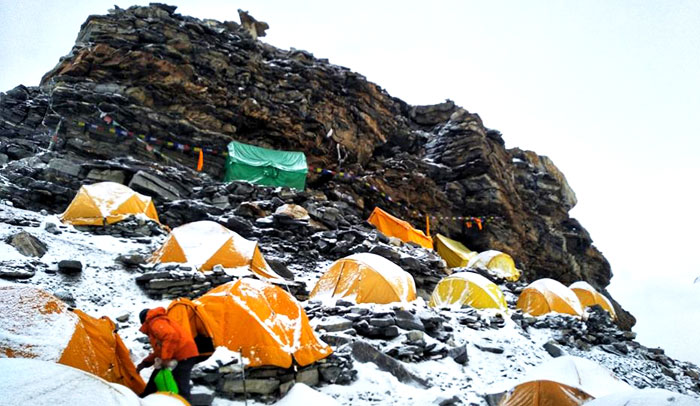
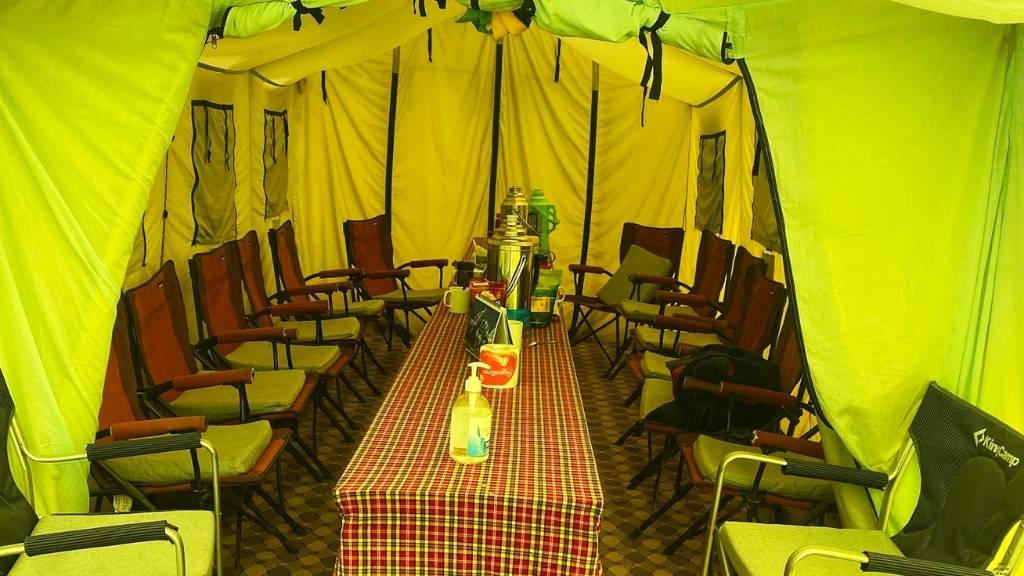
Tented camp at approximately 5,100m on the moraine shelf below the peak. Sleeping tent (2-person, with insulated mattress), dining tent, and toilet tent provided. The summit climbing gear is organised and checked here the afternoon before the summit push.
Island Peak: Detailed Technical Climbing Notes
Island Peak is Nepal’s most climbed trekking peak, but it is a genuine mountaineering objective that demands respect, preparation, and proper equipment. Here is exactly what the route involves:
The Four Phases of the Summit Route
Phase 1: Base Camp to Glacier Entry (5,400m), 1 to 2 hours Departing at midnight in the dark, the first section is a steep rocky scramble through boulders and moraine. Crampons are put on at the glacier entry point. This section is cold, dark, and physically demanding, good headlamp batteries and warm layering are essential.
Phase 2: Glacier Traverse, 1 to 2 hours Rope up as a team and traverse the glacier. The angle is moderate, around 25–35 degrees, but crevasses require careful navigation with your guide. As the sky begins to lighten, the surrounding peaks reveal themselves in extraordinary early morning light.
Phase 3: The Headwall, 1 to 2 hours the crux of Island Peak. A 50–60-degree ice and snow slope of approximately 150 metres, equipped with fixed ropes. Climbers ascend using a jumar (mechanical ascender) clipped to the rope, with ice axe in the uphill hand and crampons front-pointing into the ice. This is the most aerobically demanding section of the climb and the point where altitude, cold, and fatigue combine most intensely. Sunrise typically occurs during the headwall ascent, one of the most memorable moments of any Himalayan climb.
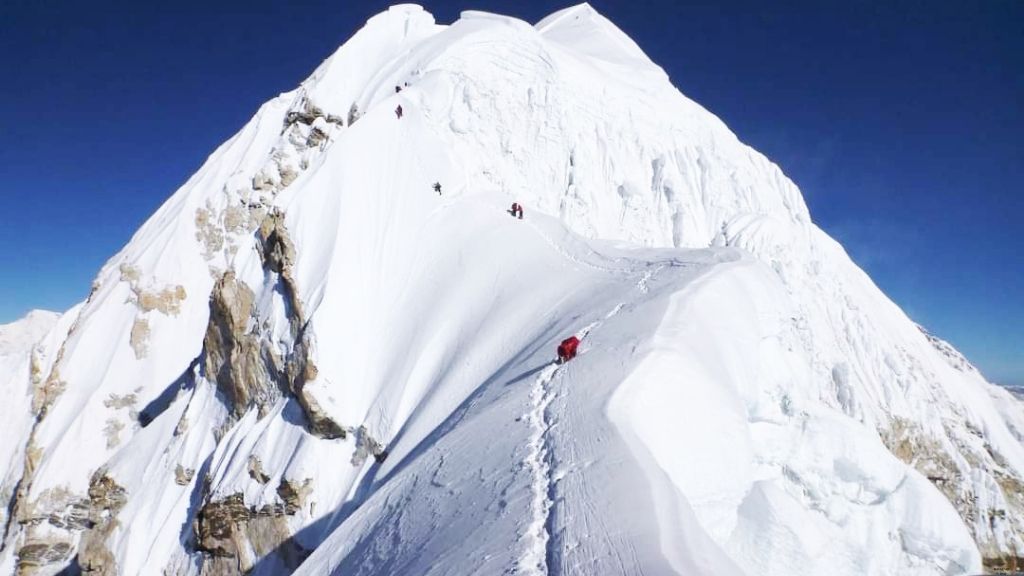
Phase 4: Summit Ridge, 30 to 60 minutes from the top of the headwall, a narrow, exposed snow and rock ridge leads to the true summit. The ridge requires careful footwork and concentration, there are steep drops on both sides. Move slowly, stay roped, and follow your guide’s instructions precisely.
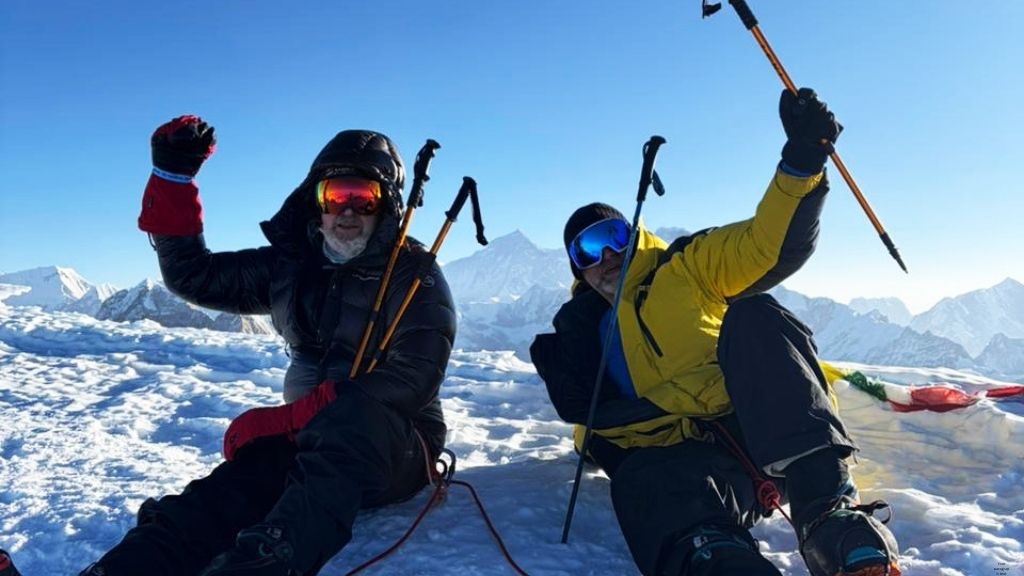
The Summit (6,189m): A small, exposed platform of snow and rock with one of the finest panoramas in all of Nepal. The dominant view is the enormous south face of Lhotse (8,516m) directly to the north, an overwhelming wall of rock and ice. Baruntse (7,162m) rises above the Imja Glacier to the east. Makalu (8,485m) stands on the horizon. Ama Dablam (6,812m) appears in perfect form to the southwest. On clear days, Everest’s summit pyramid is visible above the Lhotse-Nuptse ridge to the northwest.
Technical Equipment Used on the Climb
| Item | Notes |
| Mountaineering boots | Double-layer recommended; available to rent in Kathmandu |
| 12-point crampons | Strap-on or step-in, compatible with mountaineering boots |
| Ice axe | Standard 60–70cm general mountaineering axe |
| Sit harness | For clipping into fixed ropes |
| Ascender / jumar | For ascending the headwall fixed ropes |
| Locking carabiners | Minimum 2 per climber |
| Climbing helmet | Mandatory for rockfall protection |
| Headlamp with spare batteries | Essential summit push begins at midnight |
| Down jacket | At least 700-fill; worn throughout the climb above glacier |
| Windproof hard shell | Outer layer against summit wind |
| Warm gloves and liner gloves | Critical, fingers must be functional on the rope |
| Balaclava and warm hat | Head and face protection at altitude |
| Sunglasses and glacier goggles | Essential, UV exposure on glacier is intense |
Altitude Acclimatisation: How Our Itinerary Keeps You Safe
The single most important factor in a successful Island Peak summit is proper acclimatisation. This itinerary has been specifically designed with altitude safety as the primary engineering principle:
The acclimatisation arc:
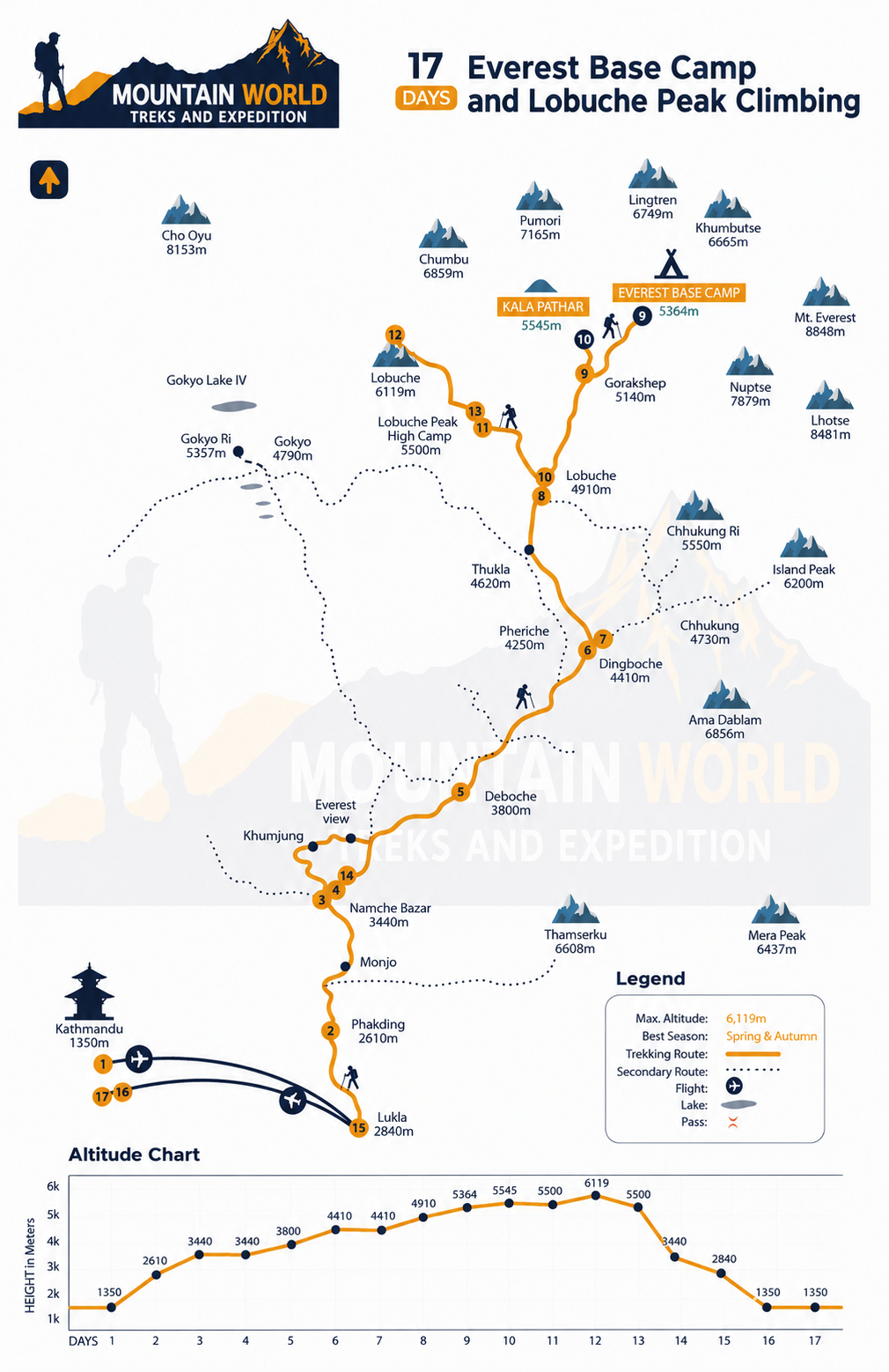
| Day | Location | Altitude | Purpose |
| Day 1 | Phakding | 2,610m | Gentle introduction |
| Day 2 | Namche Bazaar | 3,440m | First significant altitude |
| Day 3 | Namche (rest day) | 3,440m–3,880m | Adapt, hike high, sleep low |
| Day 4 | Debuche | 3800m | Progressive ascent |
| Day 5-6 | Dingboche (rest day) | 4,360m–5,050m | Critical adaptation day |
| Day 7 | Chhukung | 4,730m | Final valley acclimatisation |
| Day 8 | Base Camp | 5,100m | Pre-summit rest |
| Day 9 | Island Peak Summit | 6,189m | Summit push from fully adapted base |
Our safety protocols:
- All guides carry pulse oximeters, blood oxygen levels are checked every evening above 4,000m
- Diamox (Acetazolamide) is available on request, consult your doctor before departure
- Guides are trained in Wilderness First Aid and high-altitude medicine
- Emergency helicopter evacuation is accessible from Chhukung and Dingboche
- Descent is mandatory at the first signs of serious AMS, HACE, or HAPE, no summit is worth your life
Chhukung Valley: The Hidden Gem of the Khumbu
Most trekkers heading for Everest Base Camp never enter the Chhukung Valley, they follow the main trail to Lobuche and EBC. This makes Chhukung one of the most beautiful and authentically quiet corners of the entire Khumbu, and one of the great privileges of the Island Peak route.
The valley stretches east from Dingboche along the Imja Khola river, flanked by the massive walls of the Lhotse-Nuptse ridge to the north and the peaks of Ama Dablam, Amphu Lapcha, and the Island Peak massif to the south and east. At its head lies the Imja Tsho glacial lake, one of Nepal’s largest and most monitored glacial lakes, formed by the retreat of the Imja Glacier over the past decades.
The village of Chhukung (4,730m) consists of a handful of stone teahouses that serve as a base for Island Peak climbers, Amphu Lapcha pass crossings, and the occasional Baruntse expedition. In the summer grazing season, yak herders bring their animals up from lower valleys, and the high pastures around the village are dotted with yaks and their calves.
From Chhukung Ri above the village, the panorama is one of the finest in the Khumbu, Lhotse’s south face, the highest unclimbed wall in the world until 1990, fills the northern sky in its entirety. Standing here at 5,550m the day before your summit push, you understand exactly what you are about to attempt, and why.
Sherpa Culture and the Khumbu Region
The Khumbu is the ancestral homeland of the Sherpa people, a Tibetan-origin Buddhist ethnic group who migrated from the Kham region of eastern Tibet approximately 500 years ago and settled the high valleys of the Solukhumbu district. The name “Sherpa” literally means “people of the east” in Tibetan.
Today the Sherpa are world-renowned as expert high-altitude guides and mountaineers, but their culture, religion, and community life are far richer and more complex than their mountaineering reputation alone. On the Island Peak route, you will encounter:
Namche Bazaar, the commercial, cultural, and social capital of the Khumbu. Once a seasonal trading post between Tibetan salt traders and lowland grain farmers, it is now a vibrant mountain town with bakeries, espresso bars, trekking agencies, a hospital, a school, and a weekly Saturday market that draws traders from across the region.
Tengboche Monastery (Thyangboche Gompa), passed on Day 6, this is the most important Buddhist monastery in the Khumbu, home to the head lama of the Khumbu and a community of monks. Founded in 1916 and rebuilt after a devastating fire in 1989, it sits at 3,867m on a forested ridge with one of the most magnificent mountain backdrops in the world; Ama Dablam, Everest, Lhotse, and Nuptse rising above the monastery roof.
Pangboche, the oldest permanently inhabited village in the Khumbu, passed on Day 6 between Tengboche and Dingboche. The lower Pangboche Monastery is one of the oldest in the region and houses what are claimed to be yeti relics, a skull and a hand, though the authenticity of these items has been debated for decades.
Mani walls and chortens, the trail to Chhukung is lined with mani walls (long stone walls carved with the Buddhist mantra Om Mani Padme Hum) and chortens (white-painted stone stupas containing religious relics). Always pass these sacred structures on the left-hand side as a mark of respect.
Prayer flags, lungta (wind horses) carry prayers skyward from every ridge, pass, teahouse roof, and suspension bridge in the Khumbu. The five colours represent the five elements: blue (sky/space), white (air/wind), red (fire), green (water), and yellow (earth).
Island Peak Climbing Package Highlights
- Summit Island Peak / Imja Tse (6,189m), Nepal's most popular trekking peak and a genuine Himalayan mountaineering achievement
- Trek through Sagarmatha National Park, a UNESCO World Heritage Site protecting one of the world's most extraordinary mountain ecosystems
- Experience Sherpa culture and hospitality, in Lukla, Namche Bazaar, and the high Khumbu villages
- Close-up views of Lhotse (8,516m), Ama Dablam (6,812m), Baruntse (7,162m), Makalu (8,485m), Nuptse (7,861m), and on a clear day, the summit pyramid of Everest
- Explore Namche Bazaar, the vibrant Sherpa capital of the Khumbu at 3,440m
- Trek the beautiful and serene Chhukung Valley, one of the hidden gems of the entire Khumbu
- Acclimatisation hike to Chhukung Ri (5,550m), extraordinary 360-degree views and the perfect warm-up for summit day
- Fly into and out of Lukla (Tenzing-Hillary Airport), one of the world's most dramatic mountain airstrips
- Professional licensed Sherpa climbing guide with full technical summit equipment provided
- Small group sizes for personalised guidance and safety