QUICK ANSWER
On the Mardi Himal trek you sleep in teahouses, simple family-run lodges, every night, and eat where you stay. Rooms are basic twin-share with shared bathrooms and provided blankets. Menus centre on dal bhat, noodles, rice, soups and eggs, with prices rising the higher you climb.
A sleeping bag is recommended for the cold nights at High Camp. Vegetarian food is easy to find, hot showers, charging and wifi are paid extras, and in peak season it is worth having your guide book the higher lodges ahead.
Mardi Himal Food and Accommodation: On this page
- Where you sleep: teahouses on the trek
- Rooms and facilities
- Accommodation stop by stop
- Food: what to expect on the menu
- Dal bhat and popular dishes
- Sample menu prices
- Drinks and drinking water
- Dietary needs and restrictions
- Food safety and hygiene
- Booking and peak-season availability
- Tips for eating and sleeping well
- Frequently asked questions
- Sources
One of the joys of the Mardi Himal trek is that you never have to camp or carry food. A well-established chain of teahouses lines the route, so every night you have a bed and a hot meal, and every day you can stop for tea and lunch along the way. The comfort is basic and gets simpler as you climb, but it is warm, friendly and more than enough for a short trek. This guide explains exactly what to expect from the lodges and the food, what things cost, and how to eat and sleep well at altitude.
For where these stops fall on the route, see our Mardi Himal itinerary, and for how food and lodging fit the overall budget, the cost guide.
A warm sleeping bag for the cold teahouse nights is on our packing list, eating well supports acclimatisation in the altitude sickness guide, and peak-season booking pressure is covered in the best time guide.
Where you sleep: teahouses on the trek
Teahouses are small, family-run mountain lodges that provide both a place to sleep and a dining hall where meals are cooked and served. They are the heart of trekking life in Nepal, and staying in them means you are supporting the local families who run them. On Mardi Himal the lodges are relatively new compared with older trails, since the route only opened to trekking in recent years, so many are in good condition, though the higher you go the more basic they become.
The unwritten custom is that you eat dinner and breakfast at the teahouse where you sleep. In return, rooms are cheap, sometimes almost free in quiet periods, because the lodge earns its living from the food. It is considered poor form to sleep at one lodge and eat at another, and your guide will steer you to teahouses they know and trust.
Rooms and facilities
Set your expectations for simple, clean and functional rather than comfortable. Here is what the typical teahouse offers, and how it changes with altitude.
| Facility | What to expect |
| Rooms | Basic twin-share, thin walls, a bed with a mattress, pillow and blankets |
| Bathrooms | Usually shared; a mix of western and squat toilets, simpler higher up |
| Hot showers | Gas or solar heated, paid extra, and limited or unavailable at the top camps |
| Charging | Paid per device in the dining hall; unreliable at the highest lodges |
| Wifi | Available at some lower lodges, often paid and patchy; rare above the treeline |
| Heating | Only the dining hall is heated, usually by a stove lit in the evening |
| Blankets | Provided, but a sleeping bag is recommended for warmth high up |
The dining hall is the social hub of every teahouse, the one warm room where trekkers gather around the stove in the evening. Rooms themselves are not heated, which is why a good sleeping bag matters at High Camp and Base Camp.
Accommodation stop by stop
The standard itinerary sleeps at the stops below. There are additional lodges at points such as Kande, Australian Camp, Pothana and Low Camp, which give flexibility for shorter or longer plans.
| Night | Stop | Altitude | Character |
| 1 | Deurali (Pitam Deurali) | 2,100m | Comfortable forest lodges, a gentle first night |
| 2 | Forest Camp (Kokar) | 2,600m | Lodges tucked in the woods, atmospheric and often misty |
| 3 and 4 | High Camp | 3,600m | Dramatic ridge setting, more basic, cold at night |
| 5 | Siding village | 1,750m | Traditional Gurung village, homestays and lodges, warmer |
You visit Base Camp at 4,500m on a day trip from High Camp rather than sleeping there, so the highest place you sleep is High Camp. Low Camp, at around 2,970m, is a common alternative or extra acclimatisation stop between Forest Camp and High Camp.
Food: what to expect on the menu
Teahouse menus across the Annapurna region are surprisingly varied given where you are, and Mardi Himal is no exception. You will find a familiar core of Nepali, Tibetan and simple international dishes, all cooked fresh to order. Portions are generous, because trekkers need the calories, and the food is designed to be filling and warming rather than fancy. As you gain altitude the menu shrinks and prices rise, since every ingredient has to be carried up by porter or mule.
| Category | Typical dishes |
| Nepali staples | Dal bhat, curries, fried and steamed rice |
| Noodles and soups | Chow mein, thukpa, garlic soup, vegetable and noodle soups |
| Tibetan and dumplings | Momos, Tibetan bread, fried potatoes |
| Breakfast | Porridge, eggs, pancakes, toast with jam, muesli, chapati |
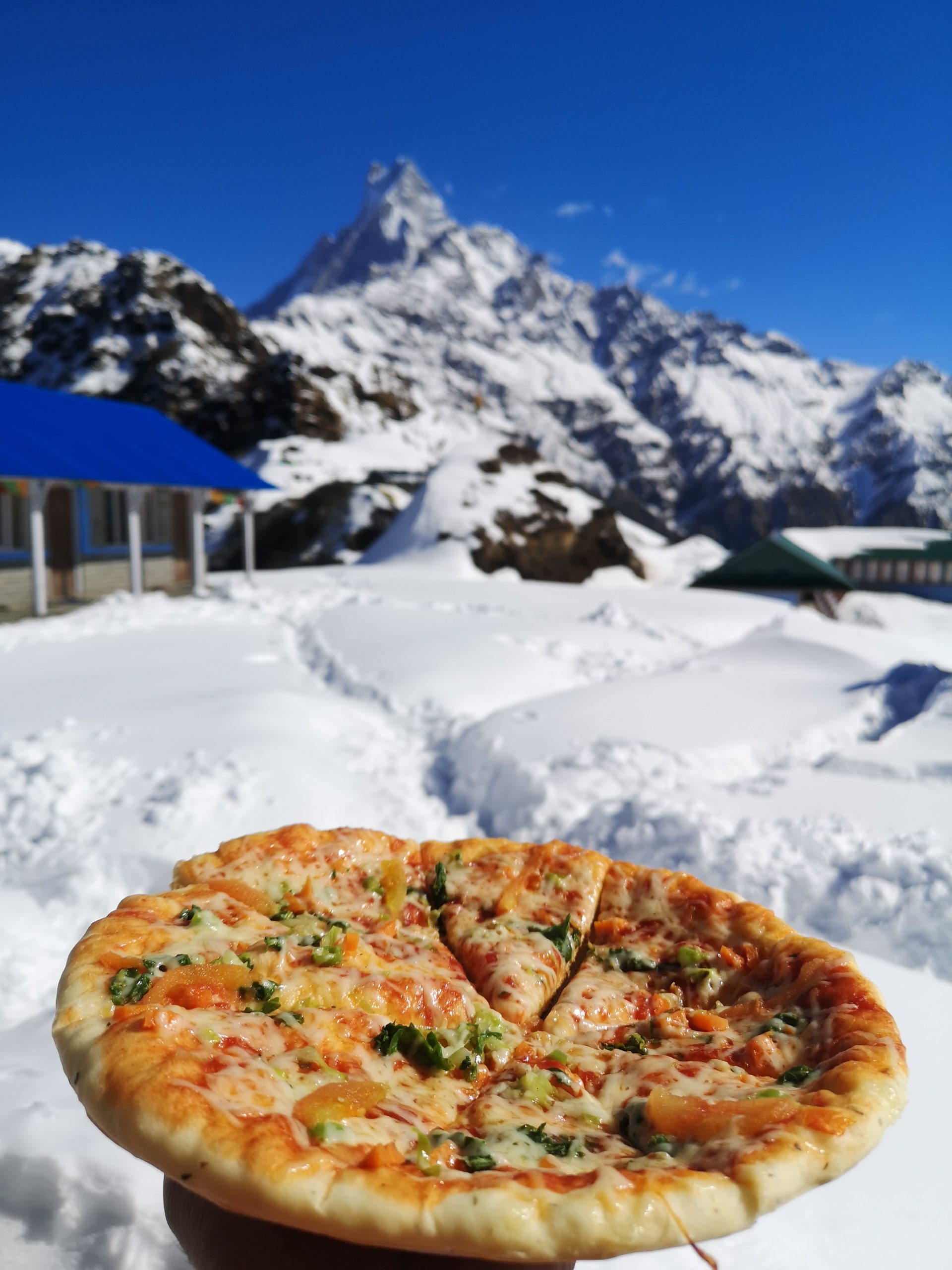
| International | Pasta, fried potatoes, simple pizza at lower lodges |
| Hot drinks and snacks | Tea, coffee, hot lemon, hot chocolate, biscuits, chocolate bars |
Dal bhat and popular dishes
If you eat one thing repeatedly on this trek, make it dal bhat, the national dish and the smartest choice on any teahouse menu. It is a plate of rice with lentil soup, a vegetable curry, and often pickles and greens, and crucially it usually comes with free refills. That makes it both the most filling meal for the money and the best fuel for a long trekking day, which is why guides and porters eat it twice a day. There is a well-known trekkers’ saying that dal bhat power lasts 24 hours.
Beyond dal bhat, the reliable favourites are garlic soup, which is also said to help with acclimatisation, warming noodle dishes like thukpa and chow mein, momos when you can get them, and simple egg and potato dishes. At breakfast, porridge and eggs give slow-release energy for the morning climb. Sticking to freshly cooked, vegetable-based meals is both the tastiest and the safest approach as you gain height.
Sample menu prices
Food is the main daily cost on the trail, and the same dish costs more the higher you climb, because of the effort of carrying supplies up the ridge. The ranges below are typical for 2026 and cover the difference between the lower and higher lodges. Budget around USD 25 to 35 per day for three meals.
| Item | Lower lodges | Higher lodges |
| Dal bhat | NPR 500 to 700 | NPR 700 to 1,000 |
| Noodles or fried rice | NPR 400 to 600 | NPR 600 to 850 |
| Momos | NPR 400 to 600 | NPR 600 to 800 |
| Eggs or pancake breakfast | NPR 300 to 500 | NPR 500 to 700 |
| Tea or coffee | NPR 80 to 200 | NPR 150 to 350 |
| Bottled water (1 litre) | NPR 100 to 200 | NPR 250 to 400 |
Prices vary by lodge and season and are shown as a guide only. Treating your own water instead of buying bottled saves money and cuts plastic waste as you climb.
For full trip budgets at different comfort levels, see the Mardi Himal cost guide.
Drinks and drinking water
Hot drinks are a big part of teahouse life, and tea, coffee, hot lemon and hot chocolate are on every menu and welcome at the end of a cold day. They are inexpensive lower down and climb in price with altitude, like everything else.
Drinking water needs a little thought. You can buy bottled water at the lodges, but it becomes expensive high up and adds plastic waste to the mountains. The better approach is to refill from taps or the lodge boiled-water supply and treat it yourself with purification tablets, drops or a filter, which is cheaper and greener. Whatever you do, keep drinking steadily through the day, since good hydration helps you cope with the altitude. Alcohol is best avoided high on the trek, because it interferes with acclimatisation.
Dietary needs and restrictions
Vegetarians are very well catered for on this trek, since dal bhat and most Nepali and Tibetan dishes are naturally vegetable-based, and eating vegetarian is also the safest choice at altitude. Vegans can manage too, though options narrow, so make your needs clear at each lodge, as ghee, butter, cheese and eggs appear in many dishes. Gluten-free and other specific diets are harder to guarantee in simple mountain kitchens, so trekkers with strict requirements should plan carefully and carry some of their own supplements or snacks.
For any allergy or intolerance, tell your guide at the start of the trek so they can explain it clearly to each teahouse in Nepali. Communicating through your guide is far more reliable than hoping the menu describes ingredients accurately, and it lets the kitchen adapt a dish for you where they can.
Food safety and hygiene
EAT SMART AT ALTITUDE
Favour freshly cooked, hot, vegetarian meals as you climb, and be cautious with meat at the higher lodges, since it has been carried up the trail without reliable refrigeration. Treat all drinking water, wash or sanitise your hands before eating, and choose busy lodges where food turns over quickly. A stomach upset high on a short trek can cost you the summit day.
None of this should make you anxious about the food, which is generally safe and freshly prepared, but a few simple habits keep it that way. Stick to hot, cooked dishes rather than anything raw or reheated, go easy on meat and dairy the higher you get, and let dal bhat, soups and vegetable dishes carry you through the upper section. Your guide will know which lodges have the best kitchens.
Booking and peak-season availability
For most of the year you can simply arrive and find a room, and your guide handles it as you go. The exception is the autumn peak, especially October, and to a lesser extent April in spring, when the higher lodges, particularly at High Camp, can fill up. Because High Camp has limited beds on a narrow ridge, this is the one place a full lodge can be a real problem.
In peak season, the simple solution is to let your guide call ahead to reserve beds at the high camps a day or two in advance, which they routinely do. Travelling slightly outside the busiest weeks, or starting the upper section early in the day to reach the lodge before it fills, also helps. Outside peak season, availability is rarely an issue and you may have quiet lodges to yourself.
Tips for eating and sleeping well
Order dal bhat for value and fuel. Free refills and balanced nutrition make it the best meal on the menu, especially before big days.
Treat your own water. It saves money, cuts plastic, and keeps you drinking enough to help with the altitude.
Bring a sleeping bag for the top. Blankets are provided, but rooms are unheated and High Camp is cold at night.
Carry small cash for extras. Showers, charging, wifi and drinks are paid on the spot, and there are no card machines or ATMs.
Warm up in the dining hall. It is the only heated room, so linger there in the evening rather than your cold bedroom.
Flag dietary needs through your guide. It is the most reliable way to have the kitchen adapt meals for allergies or a vegan diet.
Mardi himal Food and Accommodation: Frequently asked questions
Where do you sleep on the Mardi Himal trek?
You sleep in teahouses, which are simple family-run lodges, every night on the trail. On the standard itinerary that means Deurali, Forest Camp, two nights at High Camp and a night at Siding village. You visit Base Camp at 4,500m as a day trip, so the highest place you actually sleep is High Camp at 3,600m.
What are the teahouses like on Mardi Himal?
They are simple, clean and functional. Expect basic twin-share rooms with a bed, mattress and blankets, shared bathrooms, and a heated dining hall that serves as the social hub. Lodges are relatively new on this route but become more basic and colder the higher you climb, with the top camps the most spartan.
What food is available on the trek?
Menus are varied for the mountains, built around dal bhat, curries, fried rice, noodle dishes like chow mein and thukpa, momos, soups, eggs, potatoes and breakfast items such as porridge and pancakes, plus tea, coffee and snacks. The choice narrows and prices rise as you gain altitude and supplies get harder to carry up.
What is dal bhat?
Dal bhat is Nepal’s national dish, a plate of rice with lentil soup, a vegetable curry and often pickles and greens. It usually comes with free refills, which makes it the most filling and best-value meal on any teahouse menu, and the ideal fuel for a long trekking day, which is why guides and porters rely on it.
How much do meals cost on the Mardi Himal trek?
Budget around USD 25 to 35 per day for three meals. A plate of dal bhat runs roughly NPR 500 to 700 at lower lodges and NPR 700 to 1,000 higher up, with other dishes priced similarly. Everything costs more as you climb because supplies are carried up the ridge by porters.
Is there wifi and phone charging on the trek?
Some lower lodges offer wifi, usually paid and patchy, and it becomes rare above the treeline. Charging is available in the dining hall for a small fee per device, but it is unreliable at the highest lodges. Carry a power bank, and do not count on a connection at High Camp.
Are there hot showers on the trek?
Hot showers, usually gas or solar heated, are available at many lodges for a small fee, but they are limited or unavailable at the top camps. Lower down they are easy to find. Carry small cash for showers, and expect the option to disappear as you climb toward High Camp.
Do I need to book teahouses in advance?
Usually no. For most of the year you arrive and find a room, and your guide arranges it. The exception is the autumn peak, especially October, and busy April, when the higher lodges at High Camp can fill up. In peak season your guide can call ahead to reserve beds a day or two in advance.
Can I get vegetarian or vegan food on the trek?
Vegetarians are very well catered for, since dal bhat and most dishes are naturally vegetable-based, and eating vegetarian is also safest at altitude. Vegans can manage but have fewer options, as butter, cheese and eggs are common, so state your needs clearly at each lodge, ideally through your guide.
Is the food on the Mardi Himal trek safe to eat?
Generally yes, as it is freshly cooked to order. To stay safe, favour hot, cooked, vegetarian meals as you climb, be cautious with meat at the higher lodges where there is no reliable refrigeration, treat your drinking water, and sanitise your hands before eating. Busy lodges with high turnover are a good sign.
Should I eat meat on the trek?
It is best to go easy on meat as you gain altitude. Meat is carried up the trail without dependable refrigeration, so the risk of a stomach upset is higher at the top camps. Many trekkers eat vegetarian above Forest Camp, which is both safer and in keeping with what the kitchens do best.
Is the drinking water safe on the Mardi Himal trek?
Do not drink untreated tap or stream water. You can buy bottled water, but it is expensive high up and adds plastic waste, so the better choice is to refill from taps or the lodge boiled supply and treat it with tablets, drops or a filter. Keep drinking steadily, as hydration helps with the altitude.
Sources
This guide is based on the following:
- The standard nine-day Mardi Himal itinerary and its overnight stops
- Annapurna region teahouse norms for rooms, menus and facilities
- 2026 trail pricing for meals, drinks and lodge extras