The best time to trek Mardi Himal is autumn (late September to November) and spring (March to May). Autumn gives the clearest skies and the sharpest mountain views of the year, while spring brings warmer days and rhododendron forests in full bloom.
Both seasons have stable weather and reliable views. Winter is doable on this short route but cold and sometimes snowy at High Camp and Base Camp, and the summer monsoon (June to August) brings rain, leeches and clouded peaks, so most trekkers avoid it. If clear mountain views are your priority, choose October or November.
On this page
- The short answer: two best seasons
- Autumn (late September to November)
- Spring (March to May)
- Winter (December to February)
- Monsoon (June to August)
- Month-by-month at a glance
- Temperatures along the trail
- Why timing matters more on Mardi Himal
- Festivals and timing to consider
- Best time for your priority
- What to pack for each season
- Frequently asked questions
- Sources
Mardi Himal is a short, high-ridge trek, which means the season you choose has an outsized effect on what you actually see. Because so much of the trail above Low Camp is open and exposed, clear skies turn the walk into one of the great close-up mountain experiences in Nepal, while a cloudy spell can hide the very peaks you came for. This guide walks through each season in detail, gives you a month-by-month table, and helps you match the timing to whatever matters most to you, whether that is views, blooms, quiet trails or a smaller budget.
Once you have your timing, see our Mardi Himal trek itinerary for the day-by-day route and the packing list for season-specific gear.
The short answer: two best seasons
If you want the simplest possible answer, trek Mardi Himal in autumn or spring. These two windows account for the large majority of trekkers because they combine stable weather with dependable views. Autumn, running from late September through November, is the single most reliable season for clear skies. Spring, from March to May, is almost as settled and adds the spectacle of blooming rhododendron forests on the lower trail. The two off-seasons, winter and the summer monsoon, are not impossible, but each comes with real trade-offs that we explain below so you can decide with eyes open.
Autumn (late September to November)
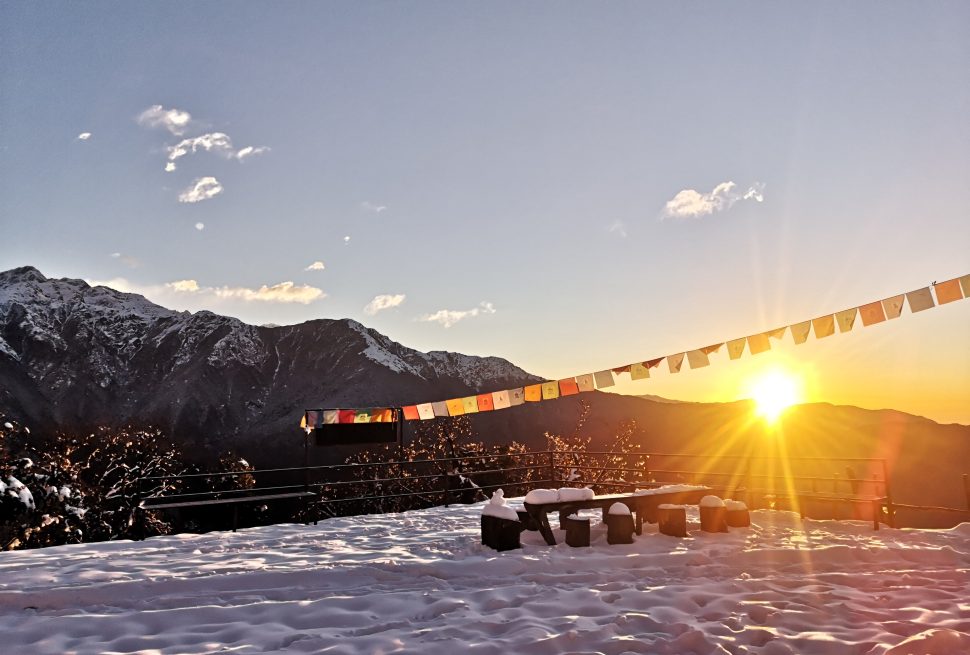
Autumn is widely considered the best season for Mardi Himal. The summer monsoon has washed the dust and haze out of the air, leaving exceptionally clear skies and crisp, sharp views of Machhapuchhre, Annapurna South and the surrounding peaks. The weather is stable and dry, the days are pleasantly mild, and the forest is green from the recent rains.
October is the peak of the peak: settled weather, comfortable temperatures and the clearest air of the year. November stays clear but turns noticeably colder, especially at night up at High Camp and Base Camp, as winter approaches. The trade-off in autumn is popularity. This is the busiest season across the whole Annapurna region, so the lodges at the higher camps fill up and prices stay firm. On a short, narrow-ridge trek like this, booking ahead through your guide is worth it in October.
Spring (March to May)
Spring is the other prime season, and for many people it is the more beautiful of the two. From March the weather settles after winter, and the lower and middle sections of the trail, particularly around Forest Camp, light up with rhododendrons in red, pink and white. Nepal’s national flower blankets these hillsides, and the contrast of blooming forest below and snow-dusted peaks above is what makes spring special on this route.
March is cooler and can still hold some winter snow on the upper ridge, April is the sweet spot for warmth and blooms together, and May is the warmest but can bring a little afternoon haze and the first pre-monsoon clouds later in the month. Views remain good throughout, though they are sometimes marginally softer than the glass-clear autumn skies. Spring is busy too, but generally a touch less crowded than October.
Winter (December to February)
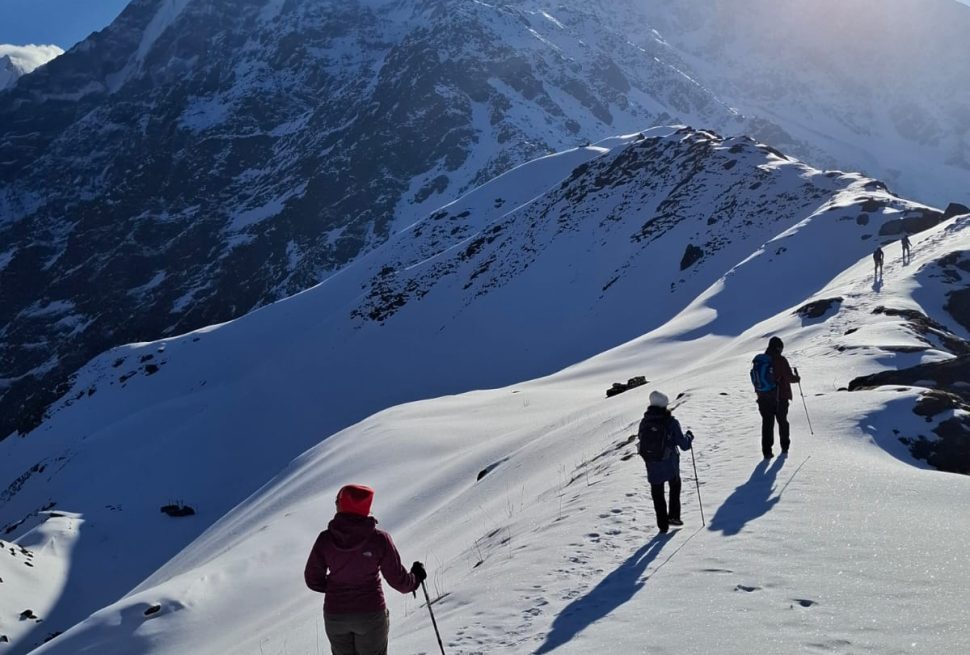
Winter trekking on Mardi Himal is genuinely possible, and it has its own appeal: empty trails, deep quiet, and on clear days some of the most dramatic snowy panoramas of the year. Because the trek is short and the lodges are well established, a winter attempt is far more realistic here than on longer, higher routes.
The catch is the cold and the snow. Nights at High Camp and Base Camp drop well below freezing, and snow is common on the upper ridge above Forest Camp, which can make the final push to Base Camp harder or occasionally impassable after heavy falls. Some of the highest lodges reduce service or close for parts of the winter, so your options thin out near the top. If you go in winter, you need proper cold-weather gear, a warm sleeping bag, and the flexibility to wait out or work around snow. The reward is solitude and crystalline views when the weather cooperates.
Monsoon (June to August)
PLAN AROUND THE WEATHER
The summer monsoon is the hardest season for Mardi Himal. Expect frequent rain, high humidity, leeches in the forest sections, slippery trails and peaks that are clouded out for much of the time. Most trekkers avoid these months.
It is not all bad news. The hills are at their greenest, the trails are at their quietest, and prices are at their lowest, with teahouses often offering rooms cheaply to anyone who eats their meals there. Determined photographers sometimes catch spectacular clear mornings between the rains, when mist rises off the forest and the peaks briefly appear. But these are gambles rather than guarantees. If you trek in the monsoon, start early each day before the cloud builds, carry good rain protection and insect cover for the leeches, and keep your itinerary flexible. For most visitors, spring or autumn is a far safer use of a limited holiday.
Month-by-month at a glance
| Month | Conditions | Crowds | Verdict |
| January | Cold, clear spells, snow up high | Very low | Quiet, for prepared winter trekkers |
| February | Cold, clearing, snow easing | Low | Good late-winter window |
| March | Warming, early rhododendrons | Moderate | Excellent, start of spring |
| April | Mild, peak blooms, clear | High | Prime season |
| May | Warm, slight haze later | Moderate to high | Very good, watch late haze |
| June | Onset of monsoon, rain | Low | Poor, cloudy and wet |
| July | Full monsoon, leeches | Very low | Avoid |
| August | Monsoon easing late | Very low | Avoid until late month |
| September | Clearing after rains (late) | Moderate | Good from late month |
| October | Clear, stable, mild | Very high | Best of the year |
| November | Clear, colder nights | High | Excellent, dress warm |
| December | Cold, clear, snow up high | Low | Quiet, for winter trekkers |
Temperatures along the trail
Because you climb from warm valleys to a 4,500m viewpoint, temperatures vary far more with altitude than they do between Kathmandu and Pokhara. Pokhara stays mild to warm all year. On the trail, the figures below are typical daytime and nighttime ranges in the main trekking seasons, and they fall further in winter and rise in the monsoon.
| Location | Daytime (peak seasons) | Night (peak seasons) |
| Pokhara (820m) | Around 20 to 30 C | Around 10 to 18 C |
| Forest Camp (2,600m) | Around 10 to 18 C | Around 2 to 8 C |
| High Camp (3,600m) | Around 5 to 12 C | Around -5 to 5 C |
| Base Camp (4,500m) | Around 0 to 8 C | Often below freezing |
In winter, subtract several degrees at every altitude and expect nights at High Camp and Base Camp well below freezing. These are guides, not forecasts, so always check conditions before you set off.
Best time for your priority
For the clearest views: October, then November and April. Autumn after the monsoon gives the sharpest air of the year.
For rhododendron blooms: April, with late March and early May close behind, on the forested lower trail.
For the fewest crowds: December to February, if you are equipped for the cold, or shoulder weeks such as early September and late November.
For the lowest cost: Winter and the monsoon, when room and food prices soften, though you trade weather and views.
For the most reliable all-round trip: October or April, which balance weather, views and open lodges better than any other months.
Why timing matters more on Mardi Himal
On most Nepali treks you walk up a river valley, where the surrounding hills block the high peaks until you are deep into the route, so a cloudy day costs you less. Mardi Himal is different. From Low Camp upward the trail follows an open mountain spine, and the peaks are in view for almost the entire upper half of the trek. That makes the experience extraordinary in clear weather and disappointing in poor weather, because there is little else to fall back on when the cloud closes in.
This is why the choice of season carries more weight here than on a sheltered valley trek, and why we steer so firmly toward autumn and spring. It is also why the early-morning push to Base Camp matters: mornings are reliably the clearest part of the day in every season, with cloud tending to build from late morning. Whatever month you choose, plan to be high on the ridge at first light to give yourself the best chance of the views the trek is famous for.
Festivals and timing to consider
Autumn coincides with Nepal’s two biggest festivals, Dashain and Tihar, which usually fall across October and into November. This is a lively and colourful time to be in the country, but it also means domestic transport, buses and flights, and city hotels are in heavy demand, and some businesses run on reduced hours during the main festival days. If you trek during this window, book transport and any city nights well ahead and build in a little buffer around the busiest dates.
Spring has no festivals on the same scale, so transport and logistics tend to run more smoothly, which is one quiet advantage of an April trip. In the off-seasons, the festivals are not a factor, but the weather and lodge availability become the main planning concerns instead. Your guide or agency will know the exact festival dates for your year and can plan the transfers around them.
What to pack for each season
Whatever the season, the temperature swing between the valley and Base Camp means you always need layers. In spring and autumn, pack for mild days and cold nights at altitude, including a warm down layer and a good sleeping bag for High Camp. In winter, add heavier insulation, gloves, a warm hat and traction for possible snow. In the monsoon, prioritise waterproofs, quick-drying clothing and protection against leeches in the forest.
For a full season-by-season kit list, see our Mardi Himal packing list. For how the seasons affect price, see the cost guide.
Frequently asked questions
When is the best time to trek Mardi Himal?
The best time is autumn, from late September to November, and spring, from March to May. Autumn offers the clearest skies and sharpest views, while spring adds blooming rhododendrons and warmer days. Both have stable weather. If clear mountain views are your priority, October and November are ideal.
Is spring or autumn better for Mardi Himal?
Both are excellent. Autumn has the clearest air of the year and the sharpest views, but it is the busiest season. Spring is almost as settled, a little less crowded, and adds rhododendron forests in full bloom on the lower trail. Choose autumn for views and spring for blooms and warmth.
Can you trek Mardi Himal in winter?
Yes. Because the trek is short with established lodges, winter is realistic here, and clear winter days give dramatic snowy views on empty trails. The trade-offs are very cold nights at High Camp and Base Camp, possible snow on the upper ridge, and some high lodges reducing service or closing.
Is the Mardi Himal trek possible during the monsoon?
It is possible but not recommended. The summer monsoon from June to August brings frequent rain, leeches in the forest, slippery trails and clouded peaks. The hills are green and prices are low, and you may catch clear mornings, but views are unreliable, so most trekkers choose spring or autumn instead.
Which month has the clearest mountain views?
October usually has the clearest views, thanks to stable, dry weather right after the monsoon clears the air. November stays very clear but colder, and April is the best spring month for views. If a sharp, cloud-free panorama of Machhapuchhre is your goal, aim for October.
When do the rhododendrons bloom on the trek?
The rhododendron forests on the lower and middle trail, especially around Forest Camp, bloom in spring, peaking around April, with displays from late March into early May. This is the main reason many trekkers choose spring, when blooming forest below contrasts with the snowy peaks above.
How cold does it get at High Camp?
In the main seasons, nights at High Camp (3,600m) typically fall to around -5 to 5 C, while days are around 5 to 12 C. In winter it is colder, dropping well below freezing at night. Bring a warm down layer and a good sleeping bag rated for sub-zero nights regardless of season.
What is the weather like at Mardi Himal Base Camp?
Base Camp sits at 4,500m, so it is the coldest and most exposed point on the trek. In peak seasons daytime temperatures hover around 0 to 8 C, and nights commonly fall below freezing. You usually visit it on an early-morning push from High Camp, when the air is clearest and the views are best.
Is Mardi Himal crowded in peak season?
It is busier than it once was, especially in October. Because it is a short trek on a narrow ridge with limited lodges at the top, the high camps can fill in peak autumn. It is still quieter than Annapurna Base Camp or Everest, but booking ahead through your guide helps in October and April.
What is the best time to avoid crowds?
For the quietest trails, go in winter, from December to February, if you are equipped for the cold, or pick shoulder weeks such as early September or late November. The monsoon is also very quiet but comes with poor weather, so winter is the better choice for solitude with views.
Does it snow on the Mardi Himal trek?
Snow is common on the upper ridge above Forest Camp in winter and into early spring, and the section to Base Camp can become harder or briefly impassable after heavy falls. In autumn and the heart of spring, snow up high is occasional rather than constant, but warm gear is always needed at the top.
How many days do I need, whatever the season?
The trekking itself is about five walking days, within a nine-day trip including arrival, the Pokhara transfers and departure. The season does not change the length, but in winter or the monsoon it is wise to keep a flexible spare day in case snow or rain forces you to wait or slow down.
Will festivals affect my Mardi Himal trek?
Possibly, if you go in autumn. Dashain and Tihar usually fall across October and into November, when domestic transport and city hotels are in heavy demand and some services run reduced hours. Book transport and city nights ahead and add a small buffer. Spring trips are generally free of festival disruption.
Are flights and transport affected by the season?
Yes. In the autumn peak, especially around the festivals, buses, domestic flights and Pokhara hotels are busiest and priciest, and weather can occasionally delay flights. In winter and the monsoon, demand is low but poor weather is more likely to disrupt flights, so keeping a spare day in your plan is sensible year-round.
Sources
Seasonal conditions and trail temperatures are based on the following:
- Annapurna region seasonal weather patterns for spring, autumn, winter and monsoon
- Typical trail temperature ranges from Forest Camp to Mardi Himal Base Camp
- 2026 Mardi Himal seasonal trekking guidance on views, crowds and lodge availability